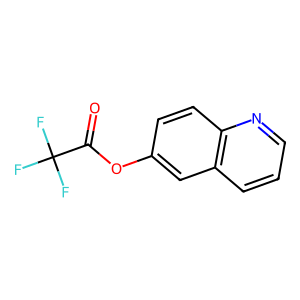
quinolin-6-yl 2,2,2-trifluoroacetate
Names and Identifiers of quinolin-6-yl 2,2,2-trifluoroacetate
CAS Number |
1000775-18-7 |
|---|---|
IUPAC Name |
quinolin-6-yl 2,2,2-tris(fluoranyl)ethanoate |
Canonical SMILES |
C1=CC2=C(C=CC(=C2)OC(=O)C(F)(F)F)N=C1 |
Physical and chemical properties of quinolin-6-yl 2,2,2-trifluoroacetate
Exact Mass |
241.03500 |
|---|---|
LogP |
2.70250 |
Molecular Formula |
C11H6F3NO2 |
Molecular Weight |
241.16600 |
PSA |
39.19000 |
Applications of quinolin-6-yl 2,2,2-trifluoroacetate
Quinolin-6-yl 2,2,2-trifluoroacetate finds applications in:
- Pharmaceutical Development: Due to its potential biological activities, it serves as a lead compound for developing new drugs targeting various diseases.
- Material Science: Its unique electronic properties make it useful in designing advanced materials, including organic semiconductors.
- Chemical Probes: It can act as a chemical probe in biological studies to elucidate mechanisms of action for quinoline-based drugs.
Interaction Studies of quinolin-6-yl 2,2,2-trifluoroacetate
Interaction studies involving quinolin-6-yl 2,2,2-trifluoroacetate often focus on its binding affinities with specific biological targets such as proteins or enzymes. These studies utilize techniques like:
- Molecular Docking: To predict how the compound interacts with target proteins.
- In Vitro Assays: To evaluate its biological activity against pathogens or cancer cell lines.
- Spectroscopic Methods: Such as nuclear magnetic resonance and mass spectrometry to analyze binding interactions.
These studies provide insights into its mechanism of action and therapeutic potential.
Biological Activity of quinolin-6-yl 2,2,2-trifluoroacetate
Quinoline derivatives are known for their diverse biological activities, including antimicrobial, anti-inflammatory, and anticancer properties. Specific studies have shown that compounds containing the quinoline structure exhibit inhibitory effects on various enzymes and cellular pathways associated with cancer progression. The trifluoroacetate group may enhance these activities by improving bioavailability or modulating pharmacokinetics.