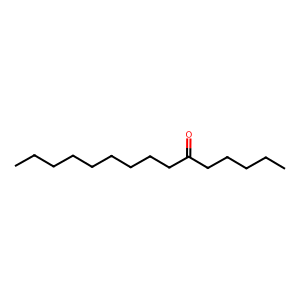
pentadecan-6-one
Names and Identifiers of pentadecan-6-one
CAS Number |
1001-45-2 |
|---|---|
IUPAC Name |
pentadecan-6-one |
Canonical SMILES |
CCCCCCCCCC(=O)CCCCC |
Physical and chemical properties of pentadecan-6-one
Boiling Point |
292.6ºC at 760mmHg |
|---|---|
Density |
0.828g/cm3 |
Exact Mass |
226.23000 |
Flash Point |
83.1ºC |
Index of Refraction |
1.436 |
LogP |
5.27650 |
Molecular Formula |
C15H30O |
Molecular Weight |
226.39800 |
PSA |
17.07000 |
Vapour Pressure |
0.00182mmHg at 25°C |
Safety Information of pentadecan-6-one
Applications of pentadecan-6-one
6-Pentadecanone has diverse applications across several industries:
- Fragrance and Flavor Industry: It is used in the formulation of perfumes and flavorings due to its pleasant odor profile.
- Chemical Intermediate: The compound serves as an intermediate in the synthesis of various organic compounds, including pharmaceuticals and agrochemicals.
- Biological Research: Its potential biological activities make it useful in research settings for studying antimicrobial effects and other therapeutic properties.
Interaction Studies of pentadecan-6-one
Studies on the interactions of 6-pentadecanone with biological systems are ongoing. Preliminary findings suggest that it may interact with cellular membranes and proteins, influencing their structure and function. These interactions could lead to metabolic transformations within biological systems, resulting in active metabolites that exert specific effects on cellular pathways.
Biological Activity of pentadecan-6-one
Research into the biological activity of 6-pentadecanone indicates potential antimicrobial and antifungal properties. Studies have shown that this compound may inhibit the growth of certain pathogens, making it a candidate for further exploration in pharmaceutical applications. Additionally, its interactions with biological molecules suggest that it could influence various cellular pathways, although detailed mechanisms remain to be fully elucidated.