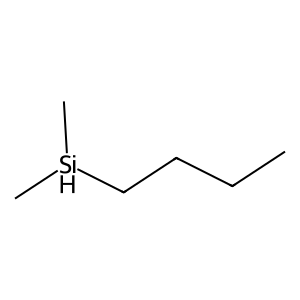
n-Butyldimethylsilane
CAS No.:
1001-52-1
M. Wt:
116.277
M. Fa:
C6H16Si
InChI Key:
HXLVDKGPVGFXTH-UHFFFAOYSA-N
Appearance:
Colorless Liquid
Names and Identifiers of n-Butyldimethylsilane
CAS Number |
1001-52-1 |
|---|---|
MDL Number |
MFCD01861696 |
InChI |
InChI=1S/C6H16Si/c1-4-5-6-7(2)3/h7H,4-6H2,1-3H3 |
InChIKey |
HXLVDKGPVGFXTH-UHFFFAOYSA-N |
Canonical SMILES |
CCCC[SiH](C)C |
UNSPSC Code |
12352100 |
Physical and chemical properties of n-Butyldimethylsilane
Boiling Point |
92.9±9.0 °C at 760 mmHg |
|---|---|
Density |
0.71 g/cm3 |
Exact Mass |
116.102127 |
Flash Point |
-4.5±3.4 °C |
Index of Refraction |
1.399525 |
LogP |
3.66 |
Molecular Formula |
C6H16Si |
Molecular Weight |
116.277 |
Vapour Pressure |
57.6±0.2 mmHg at 25°C |
Safety Information of n-Butyldimethylsilane


Applications of n-Butyldimethylsilane
n-Butyldimethylsilane has several applications:
- Protecting Group in Organic Synthesis: It is widely used to protect hydroxyl groups during multi-step syntheses.
- Silicone Production: It serves as an intermediate in the synthesis of silicone polymers and resins.
- Catalysis: It is utilized in various catalytic processes, particularly in hydrosilylation reactions that form siloxanes.
Interaction Studies of n-Butyldimethylsilane
Interaction studies involving n-butyldimethylsilane primarily focus on its reactivity with other chemical species rather than biological interactions. Its ability to act as a nucleophile makes it useful in synthesizing more complex organosilicon compounds. Additionally, studies on its stability and reactivity under different conditions (e.g., moisture or temperature) are crucial for understanding its behavior in synthetic applications.
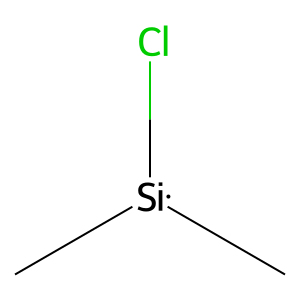 Cas:1066-35-9

 Cas:1825-62-3
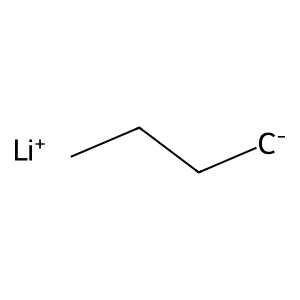 Cas:109-72-8

 Cas:75-77-4