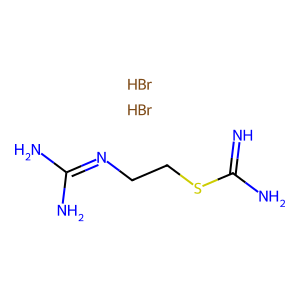
VUF 8430 dihydrobromide
Names and Identifiers of VUF 8430 dihydrobromide
CAS Number |
100130-32-3 |
|---|---|
EC Number |
663-854-9 |
IUPAC Name |
2-(diaminomethylideneamino)ethyl carbamimidothioate;dihydrobromide |
InChI |
InChI=1S/C4H11N5S.2BrH/c5-3(6)9-1-2-10-4(7)8;;/h1-2H2,(H3,7,8)(H4,5,6,9);2*1H |
InChIKey |
GPWJSTKHQMIXCA-UHFFFAOYSA-N |
Canonical SMILES |
C(CSC(=N)N)N=C(N)N.Br.Br |
Physical and chemical properties of VUF 8430 dihydrobromide
Boiling Point |
348.8ºC at 760 mmHg |
|---|---|
Exact Mass |
320.92600 |
Flash Point |
164.8ºC |
LogP |
3.00330 |
Molecular Formula |
C4H13Br2N5S |
Molecular Weight |
323.05300 |
PSA |
137.07000 |
Solubility |
deionized water: soluble24mg/mL |
Storage condition |
room temp |
Vapour Pressure |
4.91E-05mmHg at 25°C |
Safety Information of VUF 8430 dihydrobromide

Applications of VUF 8430 dihydrobromide
The primary applications of 2-(diaminomethylideneamino)ethyl carbamimidothioate; dihydrobromide include:
- Pharmaceutical Research: As a potent H4 receptor agonist, it is studied for its potential use in treating allergic and inflammatory diseases.
- Neuroscience Studies: Investigating its effects on pain pathways may provide insights into new analgesic drugs.
- Cellular Biology: Used in studies examining immune cell behavior and cytokine signaling pathways.
These applications underscore its significance in both basic research and drug development initiatives.
Interaction Studies of VUF 8430 dihydrobromide
Interaction studies involving VUF 8430 dihydrobromide focus on its binding affinity and functional effects on various receptors. Key findings include:
- Receptor Binding Affinity: High affinity for the H4 receptor (pKi = 7.5), indicating strong interaction capabilities that could lead to significant biological effects.
- Functional Assays: Studies demonstrate that activation of the H4 receptor by this compound alters immune cell migration and cytokine production, highlighting its role in modulating immune responses.
These interactions are critical for understanding how VUF 8430 dihydrobromide can be utilized therapeutically.
Biological Activity of VUF 8430 dihydrobromide
VUF 8430 dihydrobromide exhibits significant biological activity as a selective agonist for the H4 receptor. This receptor is involved in various physiological processes, including immune response modulation and inflammatory pathways. Studies have shown that activation of the H4 receptor can influence:
- Chemotaxis: The movement of immune cells towards sites of inflammation.
- Cytokine Release: Modulation of cytokine production, which plays a crucial role in immune responses.
- Pain Perception: Potential involvement in pain pathways, suggesting implications for analgesic development.
The compound's ability to selectively activate the H4 receptor positions it as a candidate for therapeutic interventions in allergic responses and other inflammatory conditions.
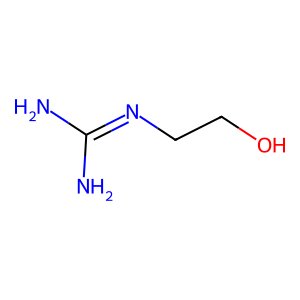 Cas:4353-52-0
