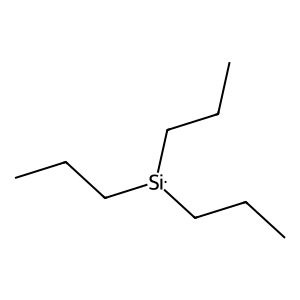
Tripropylsilane
CAS No.:
998-29-8
M. Wt:
158.357
M. Fa:
C9H22Si
InChI Key:
MMYRBBZVCDXGHG-UHFFFAOYSA-N
Appearance:
Colorless to Almost colorlessclear liquid
Names and Identifiers of Tripropylsilane
CAS Number |
998-29-8 |
|---|---|
EC Number |
213-649-1 |
MDL Number |
MFCD00009358 |
InChI |
InChI=1S/C9H21Si/c1-4-7-10(8-5-2)9-6-3/h4-9H2,1-3H3 |
InChIKey |
MMYRBBZVCDXGHG-UHFFFAOYSA-N |
Canonical SMILES |
CCC[Si](CCC)CCC |
UNII |
NNJ2F2HV9X |
UNSPSC Code |
12352100 |
Physical and chemical properties of Tripropylsilane
Boiling Point |
172.0±0.0 °C at 760 mmHg |
|---|---|
BRN |
1733500 |
Density |
0.75 |
Exact Mass |
158.149078 |
Flash Point |
43.3±0.0 °C |
Index of Refraction |
n20/D 1.426(lit.) |
LogP |
5.26 |
Molecular Formula |
C9H22Si |
Molecular Weight |
158.357 |
Storage condition |
Flammables area |
Vapour Pressure |
1.8±0.3 mmHg at 25°C |
Safety Information of Tripropylsilane


Applications of Tripropylsilane
Triisopropylsilane finds applications across various fields:
- Peptide Synthesis: It is widely used as a cation scavenger and protecting group during solid-phase peptide synthesis.
- Organic Synthesis: Employed for selective reductions and silylations, particularly where steric hindrance is beneficial.
- Chemical Research: Its unique properties make it suitable for studies involving organosilicon chemistry and reaction mechanisms.
Interaction Studies of Tripropylsilane
Interaction studies involving triisopropylsilane primarily focus on its role in peptide synthesis and its interactions with various protecting groups. Research indicates that it can enhance the efficiency of deprotection strategies by acting as both a scavenger for cations and a reducing agent. This dual role allows for greater flexibility in synthetic pathways, particularly when dealing with sensitive amino acid side chains.
Physical sample testing spectrum (NMR) of Tripropylsilane

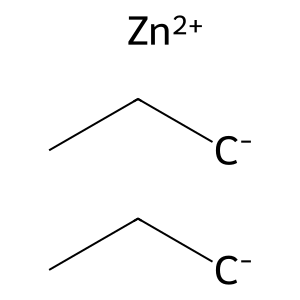 Cas:628-91-1

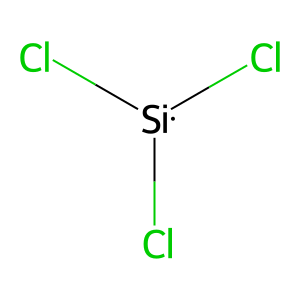 Cas:10025-78-2

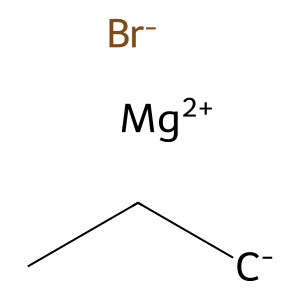 Cas:927-77-5