
Triethoxysilane
CAS No.:
998-30-1
M. Wt:
164.275
M. Fa:
C6H16O3Si
InChI Key:
PKDCQJMRWCHQOH-UHFFFAOYSA-N
Appearance:
Colorless To Green-Yellow To Yellow Liquid
Names and Identifiers of Triethoxysilane
CAS Number |
998-30-1 |
|---|---|
EC Number |
213-650-7 |
InChI |
InChI=1S/C6H15O3Si/c1-4-7-10(8-5-2)9-6-3/h4-6H2,1-3H3 |
InChIKey |
PKDCQJMRWCHQOH-UHFFFAOYSA-N |
Canonical SMILES |
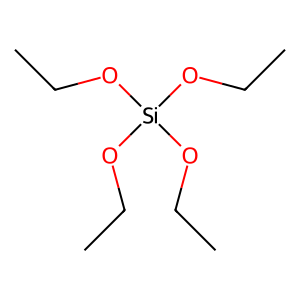
CCO[Si](OCC)OCC |
UNII |
8T460WDH89 |
Physical and chemical properties of Triethoxysilane
Boiling Point |
133.5 °C |
|---|---|
BRN |
1738989 |
Decomposition |
Hazardous decomposition products: Reacts with water to form ethanol. |
Density |
0.87 g/cm³ |
Exact Mass |
164.086868 |
Flash Point |
26 °C c.c. |
Index of Refraction |
Index of refraction: 1.337 at 20 °C |
LogP |
4.70 |
Melting Point |
-170 °C |
Molecular Formula |
C6H16O3Si |
Molecular Weight |
164.275 |
PSA |
27.69000 |
Sensitivity |
Moisture Sensitive |
Stability |
Stable, but moisture sensitive. Flammable. Incompatible with strong oxidizing agents, strong acids, strong bases. |
Storage condition |
Store at 0-5°C |
Vapour density |
Relative vapor density (air = 1): 5.7 |
Vapour Pressure |
8.5 mm Hg at 25 °C (est) |
Water Solubility |
Insoluble in water. Soluble in organic solvents. |
Safety Information of Triethoxysilane


Applications of Triethoxysilane
Triethoxysilane finds diverse applications across various fields:
- Surface Modification: It is widely used for modifying the surfaces of glass, ceramics, and metals to improve adhesion properties and hydrophobicity.
- Coatings and Sealants: The compound serves as a key ingredient in sealants and coatings that require enhanced durability and resistance to environmental factors.
- Biomedical
Interaction Studies of Triethoxysilane
Studies on the interactions of triethoxysilane with various substrates have highlighted its role in enhancing adhesion properties when applied to silica surfaces. The compound's ability to form stable siloxane bonds upon hydrolysis makes it an effective coupling agent in composite materials. Furthermore, investigations into its reactivity with different metal oxides have shown promising results for improving material performance in electronic applications.
Physical sample testing spectrum (NMR) of Triethoxysilane

 Cas:78-10-4

 Cas:122-51-0
 Cas:10025-78-2

 Cas:1825-62-3