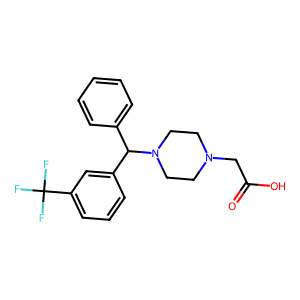
Tilapertin
CAS No.:
1000690-85-6
M. Wt:
378.388
M. Fa:
C20H21F3N2O2
InChI Key:
MDLQJNCGZVDZFV-LJQANCHMSA-N
Names and Identifiers of Tilapertin
CAS Number |
1000690-85-6 |
|---|---|
IUPAC Name |
2-[4-[(R)-phenyl-[3-(trifluoromethyl)phenyl]methyl]piperazin-1-yl]acetic acid |
InChI |
InChI=1S/C20H21F3N2O2/c21-20(22,23)17-8-4-7-16(13-17)19(15-5-2-1-3-6-15)25-11-9-24(10-12-25)14-18(26)27/h1-8,13,19H,9-12,14H2,(H,26,27)/t19-/m1/s1 |
InChIKey |
MDLQJNCGZVDZFV-LJQANCHMSA-N |
Canonical SMILES |
C1CN(CCN1CC(=O)O)C(C2=CC=CC=C2)C3=CC(=CC=C3)C(F)(F)F |
Isomeric SMILES |
C1CN(CCN1CC(=O)O)[C@H](C2=CC=CC=C2)C3=CC(=CC=C3)C(F)(F)F |
UNII |
A2SV488G98 |
Physical and chemical properties of Tilapertin
Boiling Point |
455.3±45.0 °C at 760 mmHg |
|---|---|
Density |
1.3±0.1 g/cm3 |
Exact Mass |
378.155518 |
Flash Point |
229.2±28.7 °C |
Index of Refraction |
1.554 |
LogP |
2.95 |
Molecular Formula |
C20H21F3N2O2 |
Molecular Weight |
378.388 |
Storage condition |
2-8℃ |
Vapour Pressure |
0.0±1.2 mmHg at 25°C |
Applications of Tilapertin
Tilapertin is primarily investigated for its potential applications in treating:
- Cognitive impairments: Particularly in conditions like schizophrenia and Alzheimer's disease.
- Mood disorders: By modulating glycine levels, it may help improve mood regulation.
Research continues to explore its efficacy and safety in clinical settings.
Biological Activity of Tilapertin
Tilapertin's primary biological activity stems from its role as a GlyT1 inhibitor. This inhibition leads to increased levels of glycine, which is crucial for the modulation of NMDA receptor activity. Enhanced NMDA receptor function is associated with improved cognitive processes such as learning and memory. Studies have indicated that Tilapertin may have potential benefits in conditions like schizophrenia and Alzheimer's disease by ameliorating cognitive deficits linked to these disorders.