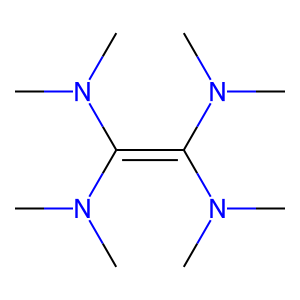
Tetrakis(dimethylamino)ethylene
CAS No.:
996-70-3
M. Wt:
200.32400
M. Fa:
C10H24N4
InChI Key:
CBXRMKZFYQISIV-UHFFFAOYSA-N
Appearance:
Yellow liquid
Names and Identifiers of Tetrakis(dimethylamino)ethylene
CAS Number |
996-70-3 |
|---|---|
EC Number |
213-638-1 |
IUPAC Name |
1-N,1-N,1-N',1-N',2-N,2-N,2-N',2-N'-octamethylethene-1,1,2,2-tetramine |
InChI |
InChI=1S/C10H24N4/c1-11(2)9(12(3)4)10(13(5)6)14(7)8/h1-8H3 |
InChIKey |
CBXRMKZFYQISIV-UHFFFAOYSA-N |
Canonical SMILES |
CN(C)C(=C(N(C)C)N(C)C)N(C)C |
UNII |
P6737B68MN |
Physical and chemical properties of Tetrakis(dimethylamino)ethylene
Acidity coefficient |
6.47±0.70(Predicted) |
|---|---|
Boiling Point |
227.1ºC at 760 mmHg |
BRN |
1705900 |
Density |
0.861 |
Exact Mass |
200.20000 |
Flash Point |
53ºC |
Index of Refraction |
1.48 |
LogP |
0.35940 |
Melting Point |
>200 °C (decomp) |
Molecular Formula |
C10H24N4 |
Molecular Weight |
200.32400 |
PSA |
12.96000 |
Stability |
Stable. Incompatible with acid chlorides, acids, strong oxidizing agents, acid anhydrides, carbon dioxide, oxygen, chlorinated solvents. Reacts with oxygen in air to give a greenish-yellow emission. Flammable. |
Storage condition |
0-10°C |
Safety Information of Tetrakis(dimethylamino)ethylene


Applications of Tetrakis(dimethylamino)ethylene
Tetrakis(dimethylamino)ethylene has several notable applications:
- Reducing Agent: It serves as a stoichiometric reductant in various organic reactions, comparable to zinc metal in reducing power.
- Organic Synthesis: Its use in asymmetric synthesis and dicarbofunctionalization reactions highlights its importance in creating complex organic molecules.
- Chemiluminescence: The compound's ability to emit light upon reaction with oxygen makes it useful in chemiluminescent applications.
Interaction Studies of Tetrakis(dimethylamino)ethylene
Tetrakis(dimethylamino)ethylene has been studied for its interactions with various electrophiles and other compounds:
- Charge-Transfer Complexes: The formation of charge-transfer complexes with fullerene indicates its potential as a donor in electron transfer processes.
- Reactivity with Polyhalogenated Compounds: Research has shown its reactivity towards polyhalogenated compounds, illustrating its utility in synthetic organic chemistry.
Physical sample testing spectrum (NMR) of Tetrakis(dimethylamino)ethylene

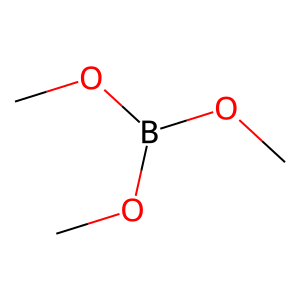 Cas:121-43-7

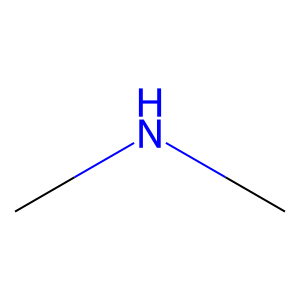 Cas:124-40-3
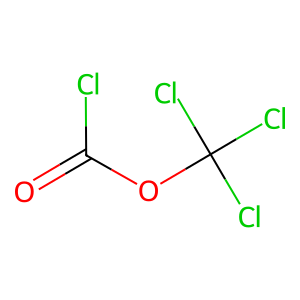 Cas:503-38-8
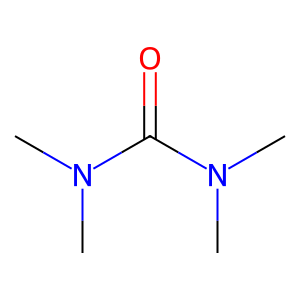 Cas:632-22-4

 Cas:5762-56-1
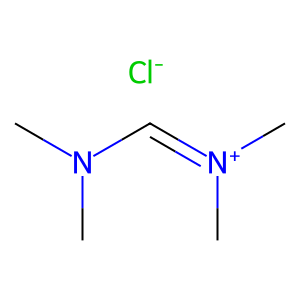 Cas:1071-38-1