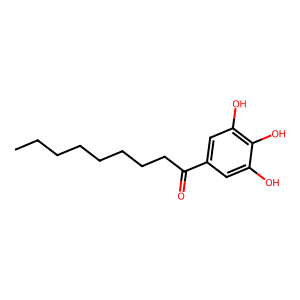
THPN
Names and Identifiers of THPN
CAS Number |
100079-26-3 |
|---|---|
IUPAC Name |
1-[3,4,5-tris(oxidanyl)phenyl]nonan-1-one |
Canonical SMILES |
CCCCCCCCC(=O)C1=CC(=C(C(=C1)O)O)O |
Physical and chemical properties of THPN
Boiling Point |
483.5ºC at 760mmHg |
|---|---|
Density |
1.148g/cm3 |
Exact Mass |
266.15200 |
Flash Point |
260.3ºC |
Index of Refraction |
1.554 |
LogP |
3.73670 |
Molecular Formula |
C15H22O4 |
Molecular Weight |
266.33300 |
PSA |
77.76000 |
Storage condition |
2-8°C |
Vapour Pressure |
5.69E-10mmHg at 25°C |
Safety Information of THPN

Applications of THPN
THPN has potential applications in cancer therapy, particularly for melanoma treatment due to its ability to induce autophagic cell death. Its specificity for Nur77 allows for targeted therapeutic strategies that may reduce side effects associated with traditional chemotherapy. Additionally, THPN's role in modulating inflammatory responses suggests potential applications in treating inflammatory diseases. Ongoing research aims to explore its efficacy further and develop derivatives that could enhance its therapeutic profile.
Interaction Studies of THPN
Studies on THPN have focused on its interactions with Nur77 and other mitochondrial proteins. The compound's ability to induce conformational changes in Nur77 upon binding is crucial for its function. Interaction studies have demonstrated that THPN facilitates the association of Nur77 with mitochondrial proteins like ANT1 (adenine nucleotide translocator), which is involved in regulating mitochondrial membrane permeability. These studies are essential for understanding the molecular mechanisms underlying THPN's biological effects and for optimizing its use as a therapeutic agent.
Biological Activity of THPN
THPN exhibits potent biological activity by specifically targeting Nur77, which plays a crucial role in regulating various cellular functions such as metabolism, inflammation, and apoptosis. In experimental models, THPN has been shown to induce autophagic cell death in melanoma cells by promoting the movement of Nur77 into mitochondria and disrupting mitochondrial functions. This mechanism is significant because it allows THPN to overcome resistance mechanisms present in melanoma cells against conventional apoptosis-inducing drugs. Furthermore, studies indicate that THPN's action can inhibit tumor development and metastasis in vivo, highlighting its potential as an anti-cancer agent.
Physical sample testing spectrum (NMR) of THPN
