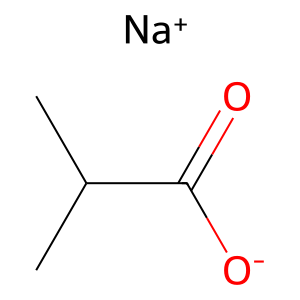
Sodium isobutyrate
CAS No.:
996-30-5
M. Wt:
110.087
M. Fa:
C4H7NaO2
InChI Key:
TWEGKFXBDXYJIU-UHFFFAOYSA-M
Appearance:
White Solid
Names and Identifiers of Sodium isobutyrate
CAS Number |
996-30-5 |
|---|---|
EC Number |
213-630-8 |
IUPAC Name |
sodium;2-methylpropanoate |
InChI |
InChI=1S/C4H8O2.Na/c1-3(2)4(5)6;/h3H,1-2H3,(H,5,6);/q;+1/p-1 |
InChIKey |
TWEGKFXBDXYJIU-UHFFFAOYSA-M |
Canonical SMILES |
CC(C)C(=O)[O-].[Na+] |
Physical and chemical properties of Sodium isobutyrate
Boiling Point |
155.2ºC at 760 mmHg |
|---|---|
Density |
0.983 g/cm3 |
Exact Mass |
110.034370 |
Flash Point |
58.2ºC |
Melting Point |
-47ºC |
Molecular Formula |
C4H7NaO2 |
Molecular Weight |
110.087 |
PSA |
40.13000 |
Storage condition |
2-8°C |
Applications of Sodium isobutyrate
Sodium isobutyrate finds applications primarily in:
- Animal Nutrition: As a feed additive to enhance growth performance, gut health, and nutrient absorption in livestock and poultry.
- Pharmaceuticals: Investigated for potential therapeutic uses due to its biological properties.
- Research: Used in studies related to gut health and metabolic processes.
Its ability to improve feed efficiency and animal health makes it a valuable compound in agricultural practices.
Interaction Studies of Sodium isobutyrate
Studies on sodium isobutyrate have focused on its interactions within biological systems. Research indicates that it can influence gut microbiota composition positively, promoting beneficial bacteria while inhibiting pathogenic strains. This modulation of gut flora contributes to improved digestion and immune responses. Additionally, its interaction with other dietary components may enhance its efficacy as a feed additive.
Physical sample testing spectrum (NMR) of Sodium isobutyrate

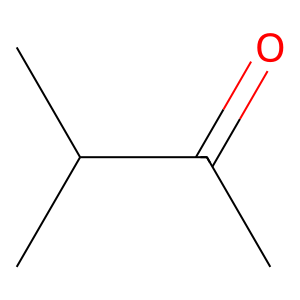 Cas:563-80-4

 Cas:97-62-1
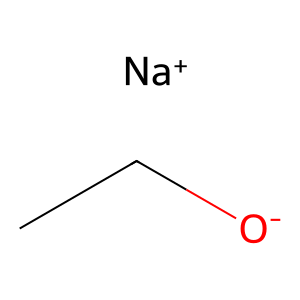 Cas:141-52-6

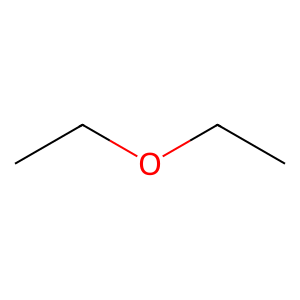 Cas:60-29-7