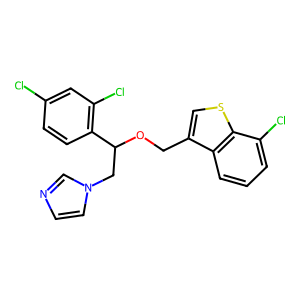
Sertaconazole
Names and Identifiers of Sertaconazole
CAS Number |
99592-32-2 |
|---|---|
EC Number |
841-355-9 |
IUPAC Name |
1-[2-[(7-chloro-1-benzothiophen-3-yl)methoxy]-2-(2,4-dichlorophenyl)ethyl]imidazole |
InChI |
InChI=1S/C20H15Cl3N2OS/c21-14-4-5-16(18(23)8-14)19(9-25-7-6-24-12-25)26-10-13-11-27-20-15(13)2-1-3-17(20)22/h1-8,11-12,19H,9-10H2 |
InChIKey |
JLGKQTAYUIMGRK-UHFFFAOYSA-N |
Canonical SMILES |
C1=CC2=C(C(=C1)Cl)SC=C2COC(CN3C=CN=C3)C4=C(C=C(C=C4)Cl)Cl |
UNII |
72W71I16EG |
Physical and chemical properties of Sertaconazole
Acidity coefficient |
6.68±0.12(Predicted) |
|---|---|
Boiling Point |
614.1±55.0 °C at 760 mmHg |
Density |
1.4±0.1 g/cm3 |
Exact Mass |
435.997070 |
Flash Point |
325.2±31.5 °C |
Index of Refraction |
1.675 |
LogP |
6.2 |
Melting Point |
146-147° |
Molecular Formula |
C20H15Cl3N2OS |
Molecular Weight |
437.770 |
PSA |
55.29000 |
Solubility |
6.37e-03 g/L |
Storage condition |
-20°C |
Vapour Pressure |
0.0±1.7 mmHg at 25°C |
Safety Information of Sertaconazole

Applications of Sertaconazole
Sertaconazole is primarily used in dermatology for treating superficial fungal infections. Its formulations include creams for topical application and vaginal tablets for treating conditions like vulvovaginal candidiasis. The drug's unique properties also make it a candidate for further research in treating other infections caused by resistant strains of fungi .
Interaction Studies of Sertaconazole
Sertaconazole interacts with various biological systems:
- Cytochrome P450 Enzymes: It selectively inhibits cytochrome P450 enzymes involved in sterol biosynthesis in fungi.
- Cell Membrane Dynamics: Sertaconazole's ability to form pores in fungal membranes suggests potential interactions with membrane phospholipids and other cellular components .
- Cytokine Release: Studies indicate that sertaconazole can modulate immune responses by affecting cytokine release from immune cells .
Adverse effects are generally mild but may include contact dermatitis and localized burning sensations upon application .
Biological Activity of Sertaconazole
Sertaconazole exhibits fungistatic and fungicidal activities against a variety of fungi. It is particularly effective against Candida albicans, Trichophyton rubrum, and other dermatophytes . The drug also demonstrates antibacterial properties and can inhibit the transformation of Candida albicans into its pathogenic form. Sertaconazole's anti-inflammatory effects are attributed to its ability to inhibit proinflammatory cytokines from activated immune cells, activating pathways such as p38/COX2/PGE2 .
Physical sample testing spectrum (NMR) of Sertaconazole

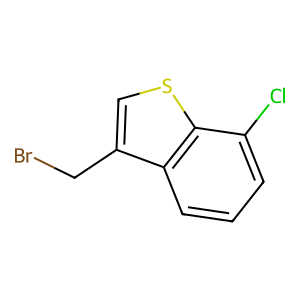 Cas:17512-61-7

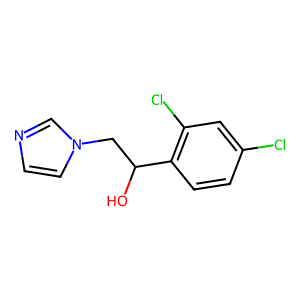 Cas:24155-42-8
