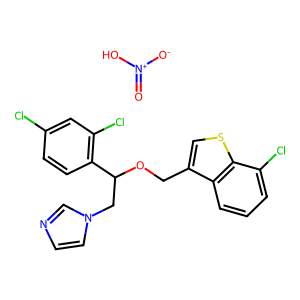
Sertaconazole nitrate
CAS No.:
99592-39-9
M. Wt:
500.783
M. Fa:
C20H16Cl3N3O4S
InChI Key:
HAAITRDZHUANGT-UHFFFAOYSA-N
Appearance:
White To Beige Powder
Names and Identifiers of Sertaconazole nitrate
CAS Number |
99592-39-9 |
|---|---|
MDL Number |
MFCD00918063 |
IUPAC Name |
1-[2-[(7-chloro-1-benzothiophen-3-yl)methoxy]-2-(2,4-dichlorophenyl)ethyl]imidazole;nitric acid |
InChI |
InChI=1S/C20H15Cl3N2OS.HNO3/c21-14-4-5-16(18(23)8-14)19(9-25-7-6-24-12-25)26-10-13-11-27-20-15(13)2-1-3-17(20)22;2-1(3)4/h1-8,11-12,19H,9-10H2;(H,2,3,4) |
InChIKey |
HAAITRDZHUANGT-UHFFFAOYSA-N |
Canonical SMILES |
C1=CC2=C(C(=C1)Cl)SC=C2COC(CN3C=CN=C3)C4=C(C=C(C=C4)Cl)Cl.[N+](=O)(O)[O-] |
UNII |
1DV05410M5 |
UNSPSC Code |
12352100 |
Physical and chemical properties of Sertaconazole nitrate
Acidity coefficient |
pKb: 7.26(at 25℃) |
|---|---|
Boiling Point |
614.1ºC at 760mmHg |
Exact Mass |
498.992706 |
Flash Point |
325.2ºC |
H Bond Acceptors |
2 |
H Bond Donors |
0 |
LogP |
7.19160 |
Melting Point |
158-160° |
Molecular Formula |
C20H16Cl3N3O4S |
Molecular Weight |
500.783 |
PSA |
121.34000 |
Solubility |
DMSO: soluble20mg/mL, clear |
Storage condition |
?20°C |
Water Solubility |
DMSO: soluble20mg/mL, clear |
Safety Information of Sertaconazole nitrate

Applications of Sertaconazole nitrate
Sertaconazole nitrate is primarily used in dermatology for treating superficial fungal infections. Its applications include:
- Topical treatment: Cream formulations are used for skin infections like athlete's foot and ringworm.
- Vaginal formulations: Available as vaginal tablets for treating candidiasis.
- Potential antibacterial applications: Ongoing research explores its use against bacterial infections due to its antibacterial properties .
Interaction Studies of Sertaconazole nitrate
Studies on sertaconazole nitrate indicate that it interacts with various biological targets:
- Cytochrome P-450 enzymes: Its primary mechanism involves inhibition of specific P-450 enzymes crucial for ergosterol biosynthesis .
- Membrane interactions: Sertaconazole's ability to form pores in fungal membranes suggests potential interactions with lipid components, affecting membrane fluidity and integrity .
- Cytokine modulation: Research suggests that sertaconazole can modulate immune responses by inhibiting pro-inflammatory cytokine release from activated immune cells .
Biological Activity of Sertaconazole nitrate
Sertaconazole exhibits several biological activities:
- Antifungal: It effectively inhibits the growth of fungi by disrupting ergosterol synthesis.
- Antibacterial: Sertaconazole has shown activity against certain bacteria, likely through similar mechanisms that affect membrane integrity.
- Antiinflammatory: The compound can inhibit the release of pro-inflammatory cytokines, reducing inflammation associated with infections.
- Antitrichomonal: It has demonstrated efficacy against Trichomonas vaginalis in vitro .
The compound's unique mechanism involving pore formation in fungal membranes sets it apart from other antifungal agents, leading to rapid cell death within hours of application .
Physical sample testing spectrum (NMR) of Sertaconazole nitrate
