
Rotigotine
CAS No.:
99755-59-6
M. Wt:
315.473
M. Fa:
C19H25NOS
InChI Key:
KFQYTPMOWPVWEJ-INIZCTEOSA-N
Appearance:
White To Almost White Powder To Crystal
Names and Identifiers of Rotigotine
CAS Number |
99755-59-6 |
|---|---|
MDL Number |
MFCD00870193 |
IUPAC Name |
(6S)-6-[propyl(2-thiophen-2-ylethyl)amino]-5,6,7,8-tetrahydronaphthalen-1-ol |
InChI |
InChI=1S/C19H25NOS/c1-2-11-20(12-10-17-6-4-13-22-17)16-8-9-18-15(14-16)5-3-7-19(18)21/h3-7,13,16,21H,2,8-12,14H2,1H3/t16-/m0/s1 |
InChIKey |
KFQYTPMOWPVWEJ-INIZCTEOSA-N |
Canonical SMILES |
CCCN(CCC1=CC=CS1)C2CCC3=C(C2)C=CC=C3O |
Isomeric SMILES |
CCCN(CCC1=CC=CS1)[C@H]2CCC3=C(C2)C=CC=C3O |
UNII |
87T4T8BO2E |
UNSPSC Code |
12352100 |
Physical and chemical properties of Rotigotine
Acidity coefficient |
10.49±0.40(Predicted) |
|---|---|
Boiling Point |
470.1±45.0 °C at 760 mmHg |
Density |
1.2±0.1 g/cm3 |
Exact Mass |
315.165680 |
Flash Point |
238.1±28.7 °C |
H Bond Acceptors |
3 |
H Bond Donors |
1 |
Index of Refraction |
1.611 |
LogP |
log Kow = 5.39 (est) |
Melting Point |
78 °C |
Molecular Formula |
C19H25NOS |
Molecular Weight |
315.473 |
PSA |
51.71000 |
Stability |
Stable under recommended storage conditions. /Rotigotine hydrochloride/ |
Storage condition |
room temp |
Vapour Pressure |
7.45X10⁻⁹ mm Hg at 25 °C (est) |
Water Solubility |
Insoluble in water |
Safety Information of Rotigotine


Key Milestone of Rotigotine
| Year | Milestones | Notes |
|---|---|---|
| 1980s | Compound Design and Synthesis | Research teams at Schering AG (later known as Berlin Chemie/Merck Group) designed and synthesized ropinirole based on the structure of dopamine receptor agonists, aiming to develop a non-ergot-derived, highly selective dopamine D₂/D₃ receptor agonist to improve the safety of Parkinson's disease treatment. |
| 1990s | Early Pharmacological Studies and Animal Model Validation | Ropinirole showed significant anti-motor symptoms effects in Parkinson's disease animal models (such as 6-OHDA lesioned rats), with a long half-life and good blood-brain barrier penetration, supporting its potential as a transdermal drug candidate. |
| 1998 | First Patent Application for Transdermal Patch | Schering AG submitted a patent application for the transdermal patch formulation of ropinirole, aiming to achieve sustained and stable drug release, avoiding first-pass metabolism and blood concentration fluctuations associated with oral administration, thereby improving patient compliance. |
| 2003 | First Approval in Europe (Neupro®) | The European Medicines Agency (EMA) approved the transdermal patch formulation of ropinirole for the treatment of early Parkinson's disease, making it the first non-ergot-derived transdermal dopamine agonist globally approved. |
| 2004 | Approval in the United States (Neupro®) | The U.S. Food and Drug Administration (FDA) approved Neupro® for the treatment of early Parkinson's disease, marking its formal use in North America. |
| 2007 | Expanded Indication: Approved for Treatment of Restless Legs Syndrome (RLS) | The FDA and EMA subsequently approved ropinirole for the treatment of moderate to severe primary restless legs syndrome (RLS), making it the first transdermal dopamine agonist approved for RLS, expanding its clinical value. |
| 2010s | Global Approval and Inclusion in Clinical Guidelines | Ropinirole was approved in countries such as Canada, Japan, and Australia, and was included in international guidelines for Parkinson's disease and RLS (such as MDS and AAN) as a first-line or second-line treatment option. |
| 2014 | Approved for Advanced Parkinson's Disease (in Combination with Levodopa) | In some countries (such as the EU), the indication was expanded to mid-to-late stage Parkinson's disease patients, as an adjunct to levodopa for controlling motor fluctuations. |
| 2020 | Generic Drugs Enter the Market | With the expiration of core patents (mainly in the US in 2019), several generic manufacturers introduced ropinirole transdermal patches, reducing treatment costs and improving accessibility. |
| 2023 Present | Ongoing Exploration of New Formulations and Indications (e.g., Neuroprotection, Depression) | Research institutions are now exploring the potential neuroprotective effects of ropinirole in neurodegenerative diseases, as well as its application prospects in treatment-resistant depression, obsessive-compulsive disorder, and other psychiatric conditions, with some studies entering preclinical or early clinical phases. |
Applications of Rotigotine
Rotigotine is primarily indicated for:
- Parkinson's Disease: It helps alleviate motor symptoms by stimulating dopamine receptors.
- Restless Legs Syndrome: It provides relief from discomfort associated with this condition.
Additionally, due to its action on various neurotransmitter systems, rotigotine has been explored for potential use in treating depression and other mood disorders.
Interaction Studies of Rotigotine
Rotigotine has several notable interactions:
- Drug Interactions: It may interact with other medications that affect dopamine levels or those metabolized by cytochrome P450 enzymes, potentially altering their efficacy or increasing side effects.
- Food Interactions: Alcohol consumption can enhance sedative effects when taken with rotigotine.
- Physiological Interactions: Caution is advised in patients with cardiovascular issues due to potential postural hypotension when initiating or increasing doses.
Biological Activity of Rotigotine
Rotigotine acts as an agonist at all five dopamine receptor subtypes (D1-D5), exhibiting the highest affinity for the D3 receptor. It also shows antagonist activity at α-2 adrenergic receptors and partial agonist activity at 5-HT1A receptors. This broad receptor activity contributes to its efficacy in treating motor symptoms associated with Parkinson's disease and may also provide antidepressant effects.
Affinity Profile| Receptor Type | Affinity (K_i in nM) |
|---|---|
| D1 | 83 |
| D2 | 13.5 |
| D3 | 0.71 |
| D4 | 3.9 |
| D5 | 5.4 |
Physical sample testing spectrum (NMR) of Rotigotine

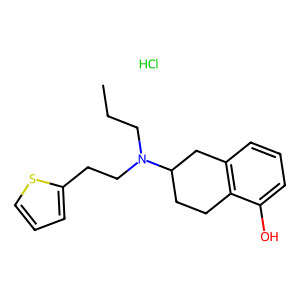 Cas:125572-93-2

 Cas:1148154-91-9
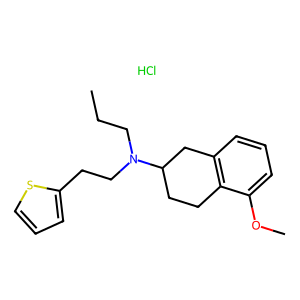 Cas:1232344-37-4