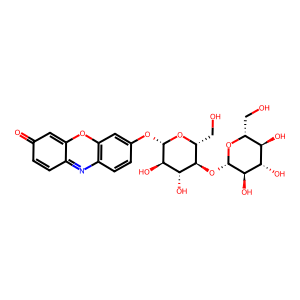
Resorufin b-D-cellobioside
Names and Identifiers of Resorufin b-D-cellobioside
CAS Number |
1000404-48-7 |
|---|---|
IUPAC Name |
7-[(2S,3R,4R,5S,6R)-6-(hydroxymethyl)-5-[(2S,3R,4S,5S,6R)-6-(hydroxymethyl)-3,4,5-tris(oxidanyl)oxan-2-yl]oxy-3,4-bis(oxidanyl)oxan-2-yl]oxyphenoxazin-3-one |
Canonical SMILES |
C1=CC2=C(C=C1O[C@H]3[C@@H]([C@H]([C@@H]([C@H](O3)CO)O[C@H]4[C@@H]([C@H]([C@@H]([C@H](O4)CO)O)O)O)O)O)OC5=CC(=O)C=CC5=N2 |
Physical and chemical properties of Resorufin b-D-cellobioside
Molecular Formula |
C24H27NO13 |
|---|---|
Molecular Weight |
537.47 |
Water Solubility |
Soluble in DMSO |
Applications of Resorufin b-D-cellobioside
Resorufin beta-D-cellobioside is widely used in biochemical assays due to its fluorescent properties. Key applications include:
- Enzyme assays: It serves as a substrate for measuring the activity of cellulases and other glycosidases.
- Research on lysosomal storage disorders: The compound aids in studying enzyme deficiencies related to conditions like Pompe disease.
- Diabetes research: It is utilized in exploring the kinetics of alpha-glucosidase inhibitors as potential therapeutic agents.
Interaction Studies of Resorufin b-D-cellobioside
Studies have shown that resorufin beta-D-cellobioside interacts with various enzymes, providing insights into their kinetic properties. For instance, it has been used to determine the kinetics of Clostridium cellulovorans endoglucanase, showcasing its role in understanding enzyme mechanisms and interactions within biochemical pathways. Additionally, its binding affinity to DNA under acidic conditions has been explored, revealing potential implications in molecular biology research.
Biological Activity of Resorufin b-D-cellobioside
Resorufin beta-D-cellobioside has shown significant biological activity as a substrate for various glycosidases, particularly cellulases. Its ability to produce a fluorescent signal upon enzymatic cleavage makes it valuable for studying enzyme kinetics and activity in biological samples. The compound has been utilized in research related to lysosomal storage disorders and diabetes, where enzymes like alpha-glucosidase are implicated.