
Propanenitrile, 3-mercapto-
CAS No.:
1001-58-7
M. Wt:
87.144
M. Fa:
C3H5NS
InChI Key:
FCTXEFOUDMXDPD-UHFFFAOYSA-N
Appearance:
Colorless To Light Yellow Liquid
Names and Identifiers of Propanenitrile, 3-mercapto-
CAS Number |
1001-58-7 |
|---|---|
EC Number |
213-682-1 |
MDL Number |
MFCD00054507 |
IUPAC Name |
3-sulfanylpropanenitrile |
InChI |
InChI=1S/C3H5NS/c4-2-1-3-5/h5H,1,3H2 |
InChIKey |
FCTXEFOUDMXDPD-UHFFFAOYSA-N |
Canonical SMILES |
C(CS)C#N |
UNII |
KTV2WN28SV |
UNSPSC Code |
12352100 |
Physical and chemical properties of Propanenitrile, 3-mercapto-
Acidity coefficient |
9.07±0.10(Predicted) |
|---|---|
Boiling Point |
203.9±23.0 °C at 760 mmHg |
Density |
1.0±0.1 g/cm3 |
Exact Mass |
87.014267 |
Flash Point |
77.1±22.6 °C |
Index of Refraction |
1.468 |
LogP |
0.25 |
Molecular Formula |
C3H5NS |
Molecular Weight |
87.144 |
PSA |
62.59000 |
Vapour Pressure |
0.3±0.4 mmHg at 25°C |
Safety Information of Propanenitrile, 3-mercapto-

Applications of Propanenitrile, 3-mercapto-
Propanenitrile, 3-mercapto- has several notable applications:
- Pharmaceuticals: Due to its biological activity, it may serve as a lead compound for developing new drugs.
- Agricultural Chemicals: Its antimicrobial properties make it a candidate for use in agricultural formulations.
- Chemical Intermediates: It can be utilized as an intermediate in organic synthesis processes.
Interaction Studies of Propanenitrile, 3-mercapto-
Interaction studies involving propanenitrile, 3-mercapto- focus on its reactivity with other compounds:
- Metal Complexation: Studies have shown that thiols can form complexes with metal ions, which may enhance the compound's utility in catalysis or as sensors.
- Biological Interactions: Investigations into how this compound interacts with biomolecules are ongoing, particularly regarding its potential therapeutic effects.
Biological Activity of Propanenitrile, 3-mercapto-
Research indicates that propanenitrile, 3-mercapto- exhibits various biological activities:
- Antioxidant Properties: The thiol group contributes to its ability to scavenge free radicals, thereby providing potential protective effects against oxidative stress.
- Antimicrobial Activity: Some studies have shown that compounds with mercapto groups possess antimicrobial properties, suggesting potential applications in pharmaceuticals.
- Cytotoxic Effects: Preliminary studies indicate that this compound may have cytotoxic effects on certain cancer cell lines, warranting further investigation into its therapeutic potential.
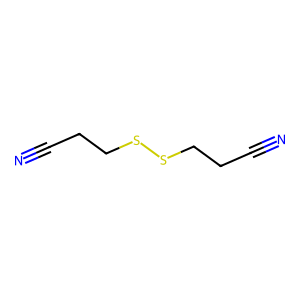 Cas:42841-31-6

 Cas:119174-33-3
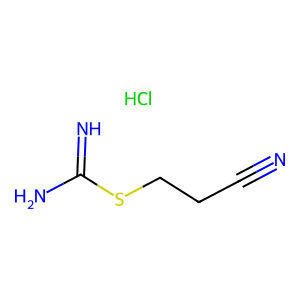 Cas:6634-40-8