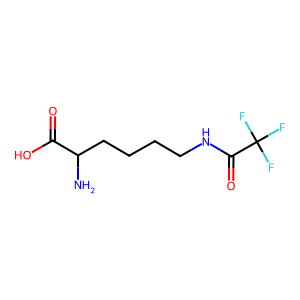
N6-(Trifluoroacetyl)-L-lysine
Names and Identifiers of N6-(Trifluoroacetyl)-L-lysine
CAS Number |
10009-20-8 |
|---|---|
EC Number |
600-027-3 |
MDL Number |
MFCD00037223 |
IUPAC Name |
(2S)-2-amino-6-[(2,2,2-trifluoroacetyl)amino]hexanoic acid |
InChI |
InChI=1S/C8H13F3N2O3/c9-8(10,11)7(16)13-4-2-1-3-5(12)6(14)15/h5H,1-4,12H2,(H,13,16)(H,14,15)/t5-/m0/s1 |
InChIKey |
PZZHRSVBHRVIMI-YFKPBYRVSA-N |
Canonical SMILES |
C(CCNC(=O)C(F)(F)F)CC(C(=O)O)N |
Isomeric SMILES |
C(CCNC(=O)C(F)(F)F)C[C@@H](C(=O)O)N |
UNSPSC Code |
12352100 |
Physical and chemical properties of N6-(Trifluoroacetyl)-L-lysine
Acidity coefficient |
2.51±0.24(Predicted) |
|---|---|
Boiling Point |
382.5±42.0 °C at 760 mmHg |
BRN |
2122429 |
Density |
1.3±0.1 g/cm3 |
Exact Mass |
242.087830 |
Flash Point |
185.1±27.9 °C |
Index of Refraction |
1.444 |
LogP |
-0.22 |
Melting Point |
258ºC |
Molecular Formula |
C8H13F3N2O3 |
Molecular Weight |
242.196 |
PSA |
92.42000 |
Solubility |
2 M HCl: 10 mg/mL, clear, colorless |
Storage condition |
2-8°C |
Vapour Pressure |
0.0±1.9 mmHg at 25°C |
Water Solubility |
2 M HCl: 10 mg/mL, clear, colorless |
Safety Information of N6-(Trifluoroacetyl)-L-lysine

Applications of N6-(Trifluoroacetyl)-L-lysine
H-Lys(Tfa)-OH finds extensive applications in:
- Peptide Synthesis: As a building block for synthesizing peptides and proteins, particularly those requiring specific post-translational modifications.
- Drug Development: In medicinal chemistry for developing novel therapeutic agents targeting various biological pathways.
- Bioconjugation: Utilized in bioconjugation strategies where it serves as a reactive handle for attaching other biomolecules.
Interaction Studies of N6-(Trifluoroacetyl)-L-lysine
Interaction studies involving H-Lys(Tfa)-OH focus on its binding properties with proteins and enzymes. These studies aim to elucidate how modifications at the lysine residue affect protein conformation and function. For instance, research has shown that lysine acetylation can mediate protein-protein interactions through recruitment mechanisms involving bromodomains, which recognize acetylated lysines.
Moreover, H-Lys(Tfa)-OH's unique trifluoroacetyl group may influence its interaction dynamics compared to unmodified lysine or other acetylated derivatives.
Biological Activity of N6-(Trifluoroacetyl)-L-lysine
H-Lys(Tfa)-OH exhibits various biological activities primarily due to its role as an amino acid derivative. Lysine itself is essential for protein synthesis and plays a crucial role in cellular metabolism. The trifluoroacetyl modification may enhance its stability and solubility in biological systems, potentially impacting its bioavailability and interaction with biological targets.
Research indicates that lysine derivatives can influence anabolic hormone secretion and may aid in mental performance during stress-related tasks. Moreover, they have been implicated in enhancing muscle recovery post-exercise by modulating metabolic pathways.
Physical sample testing spectrum (NMR) of N6-(Trifluoroacetyl)-L-lysine

 Cas:383-63-1

 Cas:56-87-1

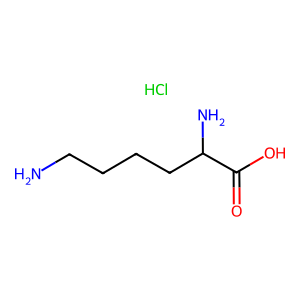 Cas:657-27-2
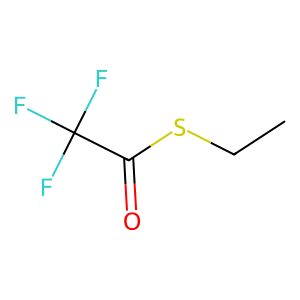 Cas:383-64-2