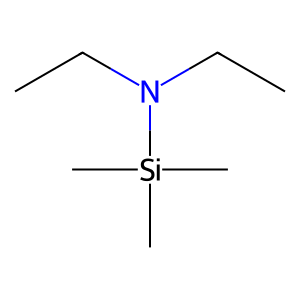
N,N-Diethyl-1,1,1-trimethylsilylamine
CAS No.:
996-50-9
M. Wt:
145.318
M. Fa:
C7H19NSi
InChI Key:
JOOMLFKONHCLCJ-UHFFFAOYSA-N
Appearance:
Colorless to Light yellow clear liquid
Names and Identifiers of N,N-Diethyl-1,1,1-trimethylsilylamine
CAS Number |
996-50-9 |
|---|---|
EC Number |
213-637-6 |
MDL Number |
MFCD00009040 |
IUPAC Name |
N-ethyl-N-trimethylsilylethanamine |
InChI |
InChI=1S/C7H19NSi/c1-6-8(7-2)9(3,4)5/h6-7H2,1-5H3 |
InChIKey |
JOOMLFKONHCLCJ-UHFFFAOYSA-N |
Canonical SMILES |
CCN(CC)[Si](C)(C)C |
UNII |
5LP9WK7P33 |
UNSPSC Code |
12352100 |
Physical and chemical properties of N,N-Diethyl-1,1,1-trimethylsilylamine
Acidity coefficient |
11.27±0.70(Predicted) |
|---|---|
Boiling Point |
126.3±0.0 °C at 760 mmHg |
BRN |
635718 |
Density |
0.8±0.1 g/cm3 |
Exact Mass |
145.128677 |
Flash Point |
10.0±0.0 °C |
Index of Refraction |
1.416 |
LogP |
2.01 |
Melting Point |
-10°C |
Molecular Formula |
C7H19NSi |
Molecular Weight |
145.318 |
PSA |
3.24000 |
Sensitivity |
Moisture Sensitive |
Storage condition |
Store at RT. |
Vapour density |
>1 (vs air) |
Vapour Pressure |
14.2±0.2 mmHg at 25°C |
Water Solubility |
decomposes |
Safety Information of N,N-Diethyl-1,1,1-trimethylsilylamine


Applications of N,N-Diethyl-1,1,1-trimethylsilylamine
The compound finds various applications in both academic and industrial settings:
- Organic Synthesis: It is widely used in organic synthesis for introducing trimethylsilyl groups into molecules.
- Gas Chromatography: Due to its ability to enhance volatility, it is often employed in gas chromatography for analyzing polar compounds.
- Chemical Research: Its reactivity makes it valuable for studying reaction mechanisms and developing new synthetic pathways.
Interaction Studies of N,N-Diethyl-1,1,1-trimethylsilylamine
Interaction studies involving N,N-Diethyl-1,1,1-trimethylsilylamine primarily focus on its reactivity with other organic compounds. These studies help elucidate its role as a silylating agent and its effectiveness in various chemical transformations. The compound's interactions with electrophiles and nucleophiles are crucial for understanding its utility in synthetic organic chemistry.
Physical sample testing spectrum (NMR) of N,N-Diethyl-1,1,1-trimethylsilylamine

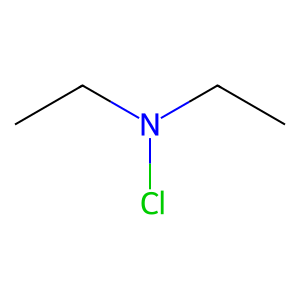 Cas:5775-33-7

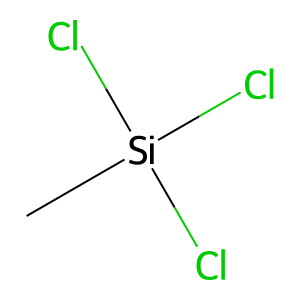 Cas:75-79-6

 Cas:127612-42-4
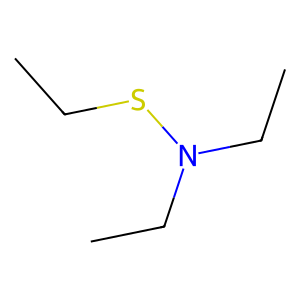 Cas:32833-97-9