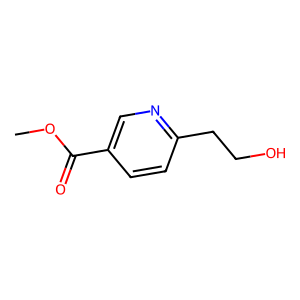
Methyl 6-(2-hydroxyethyl)nicotinate
Names and Identifiers of Methyl 6-(2-hydroxyethyl)nicotinate
CAS Number |
1000506-99-9 |
|---|---|
IUPAC Name |
methyl 6-(2-hydroxyethyl)pyridine-3-carboxylate |
InChI |
InChI=1S/C9H11NO3/c1-13-9(12)7-2-3-8(4-5-11)10-6-7/h2-3,6,11H,4-5H2,1H3 |
InChIKey |
DWNSMSJAICRYNF-UHFFFAOYSA-N |
Canonical SMILES |
COC(=O)C1=CN=C(C=C1)CCO |
Physical and chemical properties of Methyl 6-(2-hydroxyethyl)nicotinate
Exact Mass |
181.07400 |
|---|---|
LogP |
0.40300 |
Molecular Formula |
C9H11NO3 |
Molecular Weight |
181.18900 |
PSA |
59.42000 |
Safety Information of Methyl 6-(2-hydroxyethyl)nicotinate

Applications of Methyl 6-(2-hydroxyethyl)nicotinate
Methyl 6-(2-hydroxyethyl)nicotinate has a wide range of applications:
- Pharmaceuticals: Investigated for cardiovascular treatments due to its vasodilatory effects.
- Cosmetics: Used in topical formulations for pain relief and enhancing skin penetration of active ingredients.
- Chemical Research: Serves as a building block in organic synthesis and various
Interaction Studies of Methyl 6-(2-hydroxyethyl)nicotinate
Research indicates that Methyl 6-(2-hydroxyethyl)nicotinate interacts with nicotinate transporters, facilitating its cellular uptake. It enhances topical penetration in formulations, making it effective for muscle and joint pain relief. Its interactions with cellular mechanisms also promote vasodilation through prostaglandin D2 release.
Biological Activity of Methyl 6-(2-hydroxyethyl)nicotinate
This compound exhibits significant biological activity, primarily through its interaction with G protein-coupled receptors, particularly the hydroxycarboxylic acid receptors. Its mode of action is locally acting due to a short half-life, influencing biochemical pathways related to energy metabolism and lipid regulation. Methyl 6-(2-hydroxyethyl)nicotinate has been shown to enhance local blood flow and promote the release of prostaglandin D2, which is beneficial in therapeutic contexts such as pain relief and inflammation reduction.
PharmacokineticsMethyl 6-(2-hydroxyethyl)nicotinate is well-absorbed in the gastrointestinal tract and widely distributed throughout the body. Its pharmacological effects are attributed to its ability to act as a peripheral vasodilator, enhancing blood flow in the applied areas.
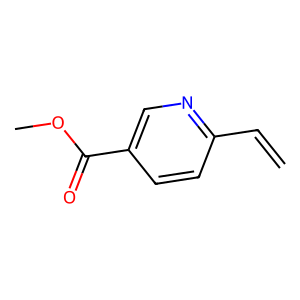 Cas:103440-76-2
