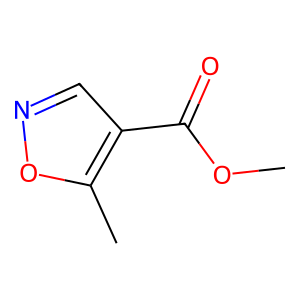
Methyl 5-methylisoxazole-4-carboxylate
Names and Identifiers of Methyl 5-methylisoxazole-4-carboxylate
CAS Number |
100047-54-9 |
|---|---|
EC Number |
600-020-5 |
IUPAC Name |
methyl 5-methyl-1,2-oxazole-4-carboxylate |
InChI |
InChI=1S/C6H7NO3/c1-4-5(3-7-10-4)6(8)9-2/h3H,1-2H3 |
InChIKey |
AHLBUWIGURZNRZ-UHFFFAOYSA-N |
Canonical SMILES |
CC1=C(C=NO1)C(=O)OC |
Physical and chemical properties of Methyl 5-methylisoxazole-4-carboxylate
Acidity coefficient |
-3.53±0.50(Predicted) |
|---|---|
Boiling Point |
211.94ºC at 760 mmHg |
Density |
1.18g/cm3 |
Exact Mass |
141.04300 |
Flash Point |
81.978ºC |
Index of Refraction |
1.468 |
LogP |
0.76960 |
Molecular Formula |
C6H7NO3 |
Molecular Weight |
141.12500 |
PSA |
52.33000 |
Vapour Pressure |
0.178mmHg at 25°C |
Applications of Methyl 5-methylisoxazole-4-carboxylate
Methyl 5-methylisoxazole-4-carboxylate has several applications in various fields:
- Medicinal Chemistry: It serves as a building block for developing pharmaceuticals targeting various diseases due to its biological activity.
- Agricultural Chemicals: Compounds derived from isoxazoles are often researched for their potential use as herbicides and fungicides.
- Material Science: Its derivatives may be utilized in creating novel materials with specific properties due to their unique chemical structure.
The compound's ability to participate in diverse reactions makes it valuable across multiple domains.
Interaction Studies of Methyl 5-methylisoxazole-4-carboxylate
Interaction studies involving methyl 5-methylisoxazole-4-carboxylate often focus on its binding affinity with biological targets. Research indicates that isoxazole derivatives can interact with enzymes or receptors, influencing their activity and leading to potential therapeutic effects. Studies using techniques such as molecular docking and spectroscopy help elucidate these interactions, providing insights into how structural modifications affect biological activity.
Biological Activity of Methyl 5-methylisoxazole-4-carboxylate
Methyl 5-methylisoxazole-4-carboxylate exhibits notable biological activities. Research indicates that derivatives of isoxazole compounds often show antimicrobial, anti-inflammatory, and anticancer properties. For instance, studies have shown that related compounds can inhibit certain enzymes or interfere with cellular pathways, leading to therapeutic effects against various diseases. The biological activity of methyl 5-methylisoxazole-4-carboxylate may stem from its ability to interact with specific biological targets due to its unique structure.