
Methyl 3-chloro-2-methylbenzoate
Names and Identifiers of Methyl 3-chloro-2-methylbenzoate
CAS Number |
99586-84-2 |
|---|---|
EC Number |
633-712-0 |
MDL Number |
MFCD00230148 |
IUPAC Name |
methyl 3-chloro-2-methylbenzoate |
InChI |
InChI=1S/C9H9ClO2/c1-6-7(9(11)12-2)4-3-5-8(6)10/h3-5H,1-2H3 |
InChIKey |
LCWKTHHPYGUFHR-UHFFFAOYSA-N |
Canonical SMILES |
CC1=C(C=CC=C1Cl)C(=O)OC |
UNSPSC Code |
12352100 |
Physical and chemical properties of Methyl 3-chloro-2-methylbenzoate
Boiling Point |
243.6ºC at 760 mmHg |
|---|---|
Density |
1.186g/cm3 |
Exact Mass |
184.02900 |
Flash Point |
111.2ºC |
Index of Refraction |
1.525 |
LogP |
2.43500 |
Melting Point |
16.5 °C |
Molecular Formula |
C9H9ClO2 |
Molecular Weight |
184.62000 |
PSA |
26.30000 |
Storage condition |
Sealed in dry,Room Temperature |
Safety Information of Methyl 3-chloro-2-methylbenzoate

Applications of Methyl 3-chloro-2-methylbenzoate
Methyl 3-chloro-2-methylbenzoate finds applications in various fields:
- Pharmaceuticals: It serves as an intermediate in the synthesis of bioactive compounds.
- Agricultural Chemicals: The compound may be utilized in developing agrochemicals due to its potential biological activity.
- Fragrance Industry: Its aromatic properties make it suitable for use in perfumes and flavoring agents.
Interaction Studies of Methyl 3-chloro-2-methylbenzoate
Interaction studies involving methyl 3-chloro-2-methylbenzoate have focused on its binding affinity to various biological targets. These studies help elucidate its potential therapeutic effects and mechanisms of action. For instance, investigations into its interactions with enzymes or receptors can reveal insights into its pharmacological profile.
Biological Activity of Methyl 3-chloro-2-methylbenzoate
Research indicates that methyl 3-chloro-2-methylbenzoate exhibits biological activities that may include antimicrobial and antifungal properties. Its structural features may contribute to its interaction with biological targets, although specific mechanisms of action are still under investigation. Studies have shown that compounds with similar structures often display varied biological activities, making them potential candidates for pharmaceutical development.
Physical sample testing spectrum (NMR) of Methyl 3-chloro-2-methylbenzoate

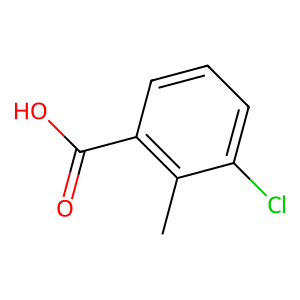 Cas:7499-08-3

 Cas:67-56-1

 Cas:74-88-4