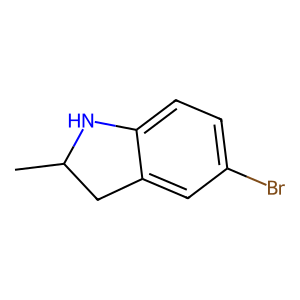
IFLAB-BB F2124-0403
Names and Identifiers of IFLAB-BB F2124-0403
CAS Number |
99847-70-8 |
|---|---|
MDL Number |
MFCD08692085 |
IUPAC Name |
5-bromo-2-methyl-2,3-dihydro-1H-indole |
InChI |
InChI=1S/C9H10BrN/c1-6-4-7-5-8(10)2-3-9(7)11-6/h2-3,5-6,11H,4H2,1H3 |
InChIKey |
NSBOZWGQLGHLQZ-UHFFFAOYSA-N |
Canonical SMILES |
CC1CC2=CC(Br)=CC=C2N1 |
UNSPSC Code |
12352100 |
Physical and chemical properties of IFLAB-BB F2124-0403
Exact Mass |
211.00000 |
|---|---|
LogP |
2.94360 |
Molecular Formula |
C9H10BrN |
Molecular Weight |
212.08600 |
PSA |
12.03000 |
Storage condition |
2-8°C |
Safety Information of IFLAB-BB F2124-0403

Applications of IFLAB-BB F2124-0403
5-bromo-2-methyl-2,3-dihydro-1H-indole finds applications in various fields:
- Medicinal Chemistry: Its derivatives are explored for their potential therapeutic effects against cancer and neurodegenerative diseases.
- Organic Synthesis: The compound serves as a building block for synthesizing more complex heterocyclic compounds.
- Material Science: Its unique properties may be utilized in developing new materials with specific electronic or optical characteristics.
Interaction Studies of IFLAB-BB F2124-0403
Research on interaction studies involving 5-bromo-2-methyl-2,3-dihydro-1H-indole has focused on its binding affinity to biological targets such as melatonin receptors. The presence of the methyl group and bromine atom influences its interaction profile, enhancing its binding efficacy compared to other indole derivatives. These studies are crucial for understanding how modifications to the indole structure can affect biological activity and lead to improved pharmacological profiles.
Biological Activity of IFLAB-BB F2124-0403
5-bromo-2-methyl-2,3-dihydro-1H-indole exhibits significant biological activity, particularly in neuroprotective and antioxidant properties. Studies indicate that derivatives of 2,3-dihydroindoles may act on melatonin receptors, suggesting potential applications in treating neurodegenerative diseases and sleep disorders. Furthermore, compounds within this class have shown promise as cytotoxic agents against various cancer cell lines, indicating their utility in anticancer drug development.
Physical sample testing spectrum (NMR) of IFLAB-BB F2124-0403

 Cas:1075-34-9

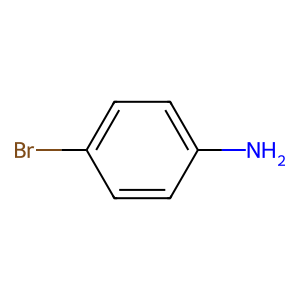 Cas:106-40-1
 Cas:267002-57-3