
Hexamethyldisilazane
Names and Identifiers of Hexamethyldisilazane
CAS Number |
999-97-3 |
|---|---|
EC Number |
213-668-5 |
MDL Number |
MFCD00008259 |
IUPAC Name |
[dimethyl-(trimethylsilylamino)silyl]methane |
InChI |
InChI=1S/C6H19NSi2/c1-8(2,3)7-9(4,5)6/h7H,1-6H3 |
InChIKey |
FFUAGWLWBBFQJT-UHFFFAOYSA-N |
Canonical SMILES |
C[Si](C)(C)N[Si](C)(C)C |
UNII |
H36C68P1BH |
UNSPSC Code |
12352100 |
Physical and chemical properties of Hexamethyldisilazane
Acidity coefficient |
30(at 25℃) |
|---|---|
Boiling Point |
125 °C |
BRN |
635752 |
Density |
0.7741 g/cu cm at 25 °C |
Exact Mass |
161.105606 |
explosive limit |
0.8-25.9%(V) |
Flash Point |
14 °C (closed cup) /from table/ |
Index of Refraction |
Index of refraction = 1.4090 @ 20 °C |
LogP |
log Kow = 2.62 /Estimated/ |
Melting Point |
-78 °C |
Merck |
14,4689 |
Molecular Formula |
C6H19NSi2 |
Molecular Weight |
161.393 |
Odor |
Ammonia-like odor |
pH Range |
8.5 |
PSA |
12.03000 |
Sensitivity |
Moisture Sensitive |
Solubility |
In water, 392 mg/l @ 25 °C /Estimated/ |
Storage condition |
Store below +30°C. |
Vapour density |
4.6 (vs air) |
Vapour Pressure |
13.8 mm Hg at 25 °C |
Water Solubility |
REACTS |
Solubility of Hexamethyldisilazane
| Solvent | Dissolution Behavior | Temperature Effect | pH Effect |
|---|---|---|---|
| Water | Insoluble, undergoes slow hydrolysis | Increased temperature accelerates hydrolysis, but does not improve solubility | Hydrolysis is accelerated under acidic or neutral conditions; relatively stable under basic conditions, yet still insoluble |
| Ethanol | Completely miscible | Solubility slightly increases with rising temperature | Strong acidic conditions may promote decomposition; stable under neutral and weakly basic conditions |
| Methanol | Completely miscible | Increased temperature enhances dissolution kinetics | Similar to ethanol; acidic environments may lead to side reactions |
| n-Hexane | Completely miscible | Minimal significant effect | No notable pH influence (non-protonic solvent) |
| Diethyl ether | Highly soluble | Small change in solubility with temperature | No significant pH effect |
| Tetrahydrofuran (THF) | Completely miscible | Increased temperature favors mixing | Stable under dry conditions; may decompose in aqueous acidic systems |
| Dichloromethane | Readily soluble | Minimal effect from temperature changes | Insensitive to pH, but may hydrolyze in the presence of moisture |
| Acetone | Soluble, but may undergo minor reaction | Heating may exacerbate reaction with trace water | Unstable under acidic conditions, prone to hydrolysis |
PPB grade of Hexamethyldisilazane
| Test Item | Technical Requirements |
|---|---|
| Appearance | Colorless, transparent liquid, free of visible impurities |
| Content (GC Purity) | ≥99.99% |
| Moisture (H₂O) | ≤10 ppb |
| Particles (≥0.1 μm, 25°C) | ≤10 pcs/mL |
| Total Metal Impurities | ≤10 ppb |
| Individual Metal Impurities (e.g., Na, K, Fe, etc.) | ≤1 ppb (each) |
| Ammonia Content (NH₃) | ≤5 ppb |
| Volatile Organic Impurities (GC-MS Analysis) | Not detected or ≤10 ppb (individual impurity) |
| Density (25°C) | 0.76–0.78 g/cm³ |
| Refractive Index (n²⁵D) | 1.395–1.400 |
| Boiling Point | 90–91°C (at atmospheric pressure) |
| pH Value (5% aqueous solution) | 9.0–11.0 |
| Vapor Pressure (25°C) | Approx. 30 mmHg |
| Packaging Cleanliness (Particle Control) | High-purity inert-lined bottles or cylinders, cleaned and passivated |
Safety Information of Hexamethyldisilazane


Key Milestone of Hexamethyldisilazane
| Year | Event/Milestone | Description |
|---|---|---|
| 1943 | First Synthesis and Structural Confirmation | Hexamethyldisilazane (HMDS) was first synthesized and characterized by American scholar E.G. Rochow and others during their research on organosilicon chemistry. This work laid the foundation for the subsequent development of organosilicon compounds. |
| 1950s | Potential as a Silylating Agent Discovered | Chemists began to recognize the potential of HMDS in protecting hydroxyl and amino functional groups, particularly showing good performance in preventing interference from moisture in reactions. |
| 1960s | Initial Application in Semiconductor Industry | HMDS was used as a pre-treatment agent on silicon wafer surfaces in photolithography processes, enhancing adhesion between photoresist and silicon substrates, significantly improving the yield of microelectronic device manufacturing. |
| 1970s | Became a Common Reagent in Organic Synthesis | HMDS was widely used in the preparation of strong amine bases such as LiHMDS, NaHMDS, and KHMDS, which play an important role in carbon–carbon bond-forming reactions. |
| 1980s | Industrial Production and Purity Improvement | With the development of microelectronics and fine chemical industries, HMDS achieved large-scale production, with high-purity (>99%) products used in semiconductor and pharmaceutical industries. |
| 1990s | Extended Applications in Materials Science | It was used in the preparation of ceramic precursors, as a silicon source in chemical vapor deposition (CVD), and as a surface modifier for hydrophobic coatings. |
| 2000s | Green Chemistry and Alternative Solvent Research | Exploration of HMDS applications in solvent systems without water or chlorine to reduce environmental impacts caused by traditional silanizing agents such as TMCS. |
| 2010s | Applications in Nanotechnology and Advanced Packaging | Used in the manufacture of 3D integrated circuits and MEMS devices as a key surface modification material, improving device stability and reliability. |
| 2020 to Present | Development of Sustainable Production Processes | Research into low-energy, low-byproduct synthesis routes for HMDS, such as catalytic amidation methods, promoting its sustainable application in green manufacturing. |
Applications of Hexamethyldisilazane
Hexamethyldisilazane has diverse applications across various fields:
- Surface Treatment: It is used in the photolithography process for treating silicon wafers, enhancing the adhesion of photoresists.
- Gas Chromatography: The compound serves as a derivatization agent in gas chromatography mass spectrometry applications.
- Silylation Reactions: Hexamethyldisilazane is employed for silylation in organic synthesis, particularly for protecting functional groups during reactions involving sensitive substrates.
- Material Science: It plays a role in the preparation of nanosilicon films and other silicon-based materials.
Interaction Studies of Hexamethyldisilazane
Studies have shown that hexamethyldisilazane interacts effectively with various functional groups, making it a versatile reagent in organic synthesis. Its reactivity allows it to participate in condensation reactions and silylation processes that are crucial for developing new materials and compounds. Research indicates that hexamethyldisilazane can also facilitate reactions involving metal chlorides to produce metal nitride precursors, showcasing its utility in inorganic chemistry.
Biological Activity of Hexamethyldisilazane
The biological activity of hexamethyldisilazane is limited, primarily due to its toxicity. Exposure can lead to respiratory tract irritation and central nervous system depression. Long-term exposure has been associated with neurotoxic effects such as ataxia. The compound can cause severe burns upon contact with skin or eyes and may release toxic nitrogen oxides when heated.
Physical sample testing spectrum (NMR) of Hexamethyldisilazane

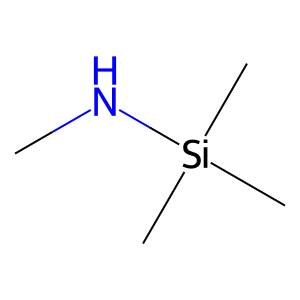 Cas:16513-17-0

 Cas:2251-46-9

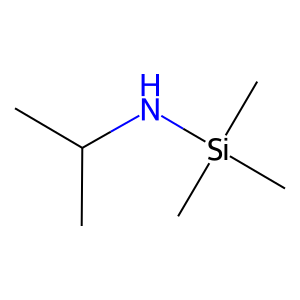 Cas:5577-65-1
 Cas:18297-63-7