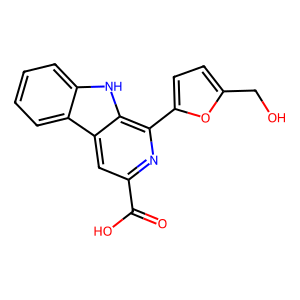
Flazin
CAS No.:
100041-05-2
M. Wt:
308.28800
M. Fa:
C17H12N2O4
InChI Key:
USBWYUYKHHILLZ-UHFFFAOYSA-N
Names and Identifiers of Flazin
CAS Number |
100041-05-2 |
|---|---|
IUPAC Name |
1-[5-(hydroxymethyl)furan-2-yl]-9H-pyrido[3,4-b]indole-3-carboxylic acid |
InChI |
InChI=1S/C17H12N2O4/c20-8-9-5-6-14(23-9)16-15-11(7-13(19-16)17(21)22)10-3-1-2-4-12(10)18-15/h1-7,18,20H,8H2,(H,21,22) |
InChIKey |
USBWYUYKHHILLZ-UHFFFAOYSA-N |
Canonical SMILES |
C1=CC=C2C(=C1)C3=CC(=NC(=C3N2)C4=CC=C(O4)CO)C(=O)O |
Physical and chemical properties of Flazin
Boiling Point |
657.1ºC at 760mmHg |
|---|---|
Density |
1.513g/cm3 |
Exact Mass |
308.08000 |
Flash Point |
351.2ºC |
Index of Refraction |
1.771 |
LogP |
3.16660 |
Melting Point |
231 - 233 °C |
Molecular Formula |
C17H12N2O4 |
Molecular Weight |
308.28800 |
PSA |
99.35000 |
Vapour Pressure |
3.69E-18mmHg at 25°C |
Applications of Flazin
Flazin has several promising applications:
- Nutraceuticals: Due to its health benefits related to diabetes management and lipid metabolism, flazin is being explored as a dietary supplement or functional food ingredient.
- Pharmaceuticals: Its potential as a therapeutic agent for metabolic disorders positions flazin as a candidate for drug development targeting diabetes and related complications.
- Research: Flazin serves as a valuable compound for studying metabolic pathways and disease mechanisms due to its unique biochemical properties.
Interaction Studies of Flazin
Research indicates that flazin interacts with various biomolecules, particularly proteins involved in metabolic processes. Molecular dynamics simulations have revealed that flazin binds to key residues in insulin, affecting its glycation state. Additionally, studies on its interaction with lipid droplets suggest that flazin alters lipid metabolism by modulating gene expression related to lipolysis and lipogenesis.
Biological Activity of Flazin
Flazin exhibits a range of biological activities, including:
- Non-Enzymatic Glycation Inhibition: Flazin effectively inhibits the glycation of proteins such as bovine serum albumin and insulin, which is essential for managing diabetes.
- Lipid Metabolism Regulation: It significantly reduces triglyceride levels and alters lipid droplet morphology, contributing to improved lipid profiles in cells.
- Antioxidant Properties: Flazin demonstrates antioxidant activity by scavenging reactive nitrogen species, thereby protecting cells from oxidative stress.
- Potential Anti-HIV Activity: Preliminary studies suggest that flazin may possess anti-HIV properties, although further research is required to substantiate these claims.