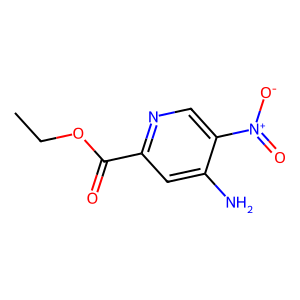
Ethyl 4-amino-5-nitropicolinate
Names and Identifiers of Ethyl 4-amino-5-nitropicolinate
CAS Number |
1000783-10-7 |
|---|---|
MDL Number |
MFCD13186745 |
IUPAC Name |
ethyl 4-amino-5-nitropyridine-2-carboxylate |
InChI |
InChI=1S/C8H9N3O4/c1-2-15-8(12)6-3-5(9)7(4-10-6)11(13)14/h3-4H,2H2,1H3,(H2,9,10) |
InChIKey |
PGSAVGAWCWMKJF-UHFFFAOYSA-N |
Canonical SMILES |
CCOC(=O)C1=NC=C(C(=C1)N)[N+](=O)[O-] |
Physical and chemical properties of Ethyl 4-amino-5-nitropicolinate
Exact Mass |
211.05900 |
|---|---|
H Bond Acceptors |
5 |
H Bond Donors |
1 |
LogP |
1.85310 |
Molecular Formula |
C8H9N3O4 |
Molecular Weight |
211.17500 |
PSA |
111.03000 |
Safety Information of Ethyl 4-amino-5-nitropicolinate

Interaction Studies of Ethyl 4-amino-5-nitropicolinate
Studies on ethyl 4-amino-5-nitropicolinate's interactions reveal its potential to modulate various biological pathways. Its nitro group can be reduced within biological systems to form active intermediates that may affect cellular functions. The amino group enhances its ability to form hydrogen bonds with proteins, which could influence enzymatic activities or receptor interactions. Understanding these interactions is crucial for evaluating its therapeutic potential.
Biological Activity of Ethyl 4-amino-5-nitropicolinate
Research indicates that ethyl 4-amino-5-nitropicolinate exhibits significant biological activities. It has been studied for its potential antimicrobial and anticancer properties. The compound's mechanism of action involves its interaction with specific molecular targets within biological systems. The nitro group can undergo bioreduction, forming reactive intermediates that may interact with cellular components, influencing various biological effects. Additionally, the amino group facilitates interactions with target proteins through hydrogen bonding.
 Cas:100047-36-7

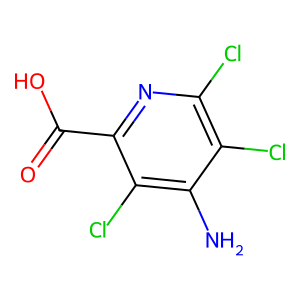 Cas:1918-02-1