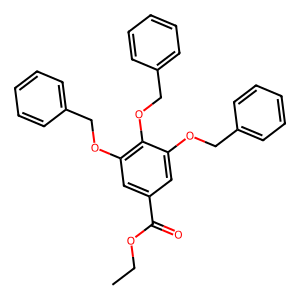
Ethyl 3,4,5-tris(benzyloxy)benzoate
CAS No.:
100079-21-8
M. Wt:
468.54000
M. Fa:
C30H28O5
InChI Key:
LPOVBWPBHYTZPB-UHFFFAOYSA-N
Names and Identifiers of Ethyl 3,4,5-tris(benzyloxy)benzoate
CAS Number |
100079-21-8 |
|---|---|
IUPAC Name |
ethyl 3,4,5-tris(phenylmethoxy)benzoate |
InChI |
InChI=1S/C30H28O5/c1-2-32-30(31)26-18-27(33-20-23-12-6-3-7-13-23)29(35-22-25-16-10-5-11-17-25)28(19-26)34-21-24-14-8-4-9-15-24/h3-19H,2,20-22H2,1H3 |
InChIKey |
LPOVBWPBHYTZPB-UHFFFAOYSA-N |
Canonical SMILES |
CCOC(=O)C1=CC(=C(C(=C1)OCC2=CC=CC=C2)OCC3=CC=CC=C3)OCC4=CC=CC=C4 |
Physical and chemical properties of Ethyl 3,4,5-tris(benzyloxy)benzoate
Exact Mass |
468.19400 |
|---|---|
LogP |
6.60030 |
Molecular Formula |
C30H28O5 |
Molecular Weight |
468.54000 |
PSA |
53.99000 |
Applications of Ethyl 3,4,5-tris(benzyloxy)benzoate
Ethyl 3,4,5-tris(benzyloxy)benzoate has potential applications in various fields:
- Pharmaceuticals: Due to its biological activity, it may serve as a lead compound for drug development.
- Cosmetics: Its antioxidant properties make it suitable for use in cosmetic formulations aimed at skin protection.
- Polymer Science: It can be used as a monomer or additive in the synthesis of polymers with specific functional properties.
Interaction Studies of Ethyl 3,4,5-tris(benzyloxy)benzoate
Interaction studies involving ethyl 3,4,5-tris(benzyloxy)benzoate often focus on its binding affinity with biological targets:
- Protein Binding: Studies may investigate how this compound interacts with proteins involved in oxidative stress and inflammation.
- Cellular Uptake: Research could explore how effectively this compound penetrates cell membranes and its subsequent effects on cellular pathways.
Such studies are crucial for understanding the pharmacokinetics and pharmacodynamics of this compound and its derivatives.
Biological Activity of Ethyl 3,4,5-tris(benzyloxy)benzoate
The biological activity of ethyl 3,4,5-tris(benzyloxy)benzoate has been explored in various studies:
- Antioxidant Properties: Compounds with similar structures have been shown to exhibit antioxidant activity, potentially due to the presence of hydroxyl groups that can scavenge free radicals.
- Antimicrobial Activity: Some derivatives have demonstrated antimicrobial properties against a range of pathogens.
- Anti-inflammatory Effects: Certain studies suggest that related compounds may possess anti-inflammatory effects, making them potential candidates for therapeutic applications.
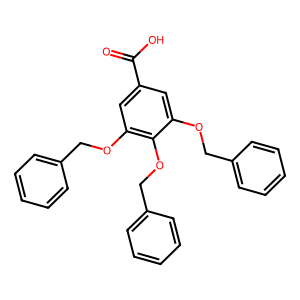 Cas:1486-48-2
