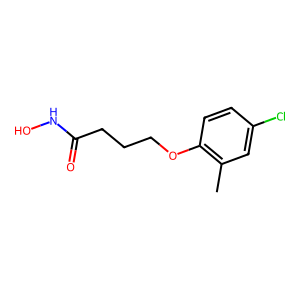
Droxinostat
Names and Identifiers of Droxinostat
CAS Number |
99873-43-5 |
|---|---|
EC Number |
662-725-4 |
MDL Number |
MFCD01326592 |
IUPAC Name |
4-(4-chloro-2-methylphenoxy)-N-hydroxybutanamide |
InChI |
InChI=1S/C11H14ClNO3/c1-8-7-9(12)4-5-10(8)16-6-2-3-11(14)13-15/h4-5,7,15H,2-3,6H2,1H3,(H,13,14) |
InChIKey |
JHSXDAWGLCZYSM-UHFFFAOYSA-N |
Canonical SMILES |
CC1=C(C=CC(=C1)Cl)OCCCC(=O)NO |
UNSPSC Code |
12352100 |
Physical and chemical properties of Droxinostat
Appearance of Characters |
white to off-white |
|---|---|
Density |
1.252 g/cm3 |
Exact Mass |
243.06600 |
H Bond Acceptors |
3 |
H Bond Donors |
2 |
LogP |
3.15310 |
Molecular Formula |
C11H14ClNO3 |
Molecular Weight |
243.68700 |
PSA |
62.05000 |
Solubility |
DMSO: ≥20mg/mL |
Storage condition |
2-8°C |
Water Solubility |
DMSO: ≥20mg/mL |
Safety Information of Droxinostat

Applications of Droxinostat
Droxinostat is primarily explored for its applications in cancer therapy due to its ability to induce apoptosis and sensitize cancer cells to treatment. Its potential uses include:
- Cancer Treatment: As an adjunct therapy in various cancers, particularly those resistant to conventional treatments.
- Research Tool: Used in studies investigating the role of histone acetylation in gene regulation and cancer biology.
Interaction Studies of Droxinostat
Studies have shown that droxinostat interacts with several cellular pathways:
- It enhances the expression of acetylated histones, leading to altered gene transcription.
- Droxinostat's induction of ROS has been linked to mitochondrial dysfunction and apoptosis.
- The compound also affects the expression levels of various antioxidant enzymes, indicating its role in oxidative stress modulation.
Biological Activity of Droxinostat
Droxinostat exhibits significant biological activity by inducing apoptosis in various cancer cell lines, including human colon cancer cells and hepatoma cell lines. It has been shown to increase the production of reactive oxygen species (ROS), which contributes to its pro-apoptotic effects. The compound's ability to downregulate anti-apoptotic factors like FLIP further enhances its efficacy as an anticancer agent. Notably, droxinostat has been demonstrated to sensitize cells to death receptor ligands, thereby restoring sensitivity in cancer cells that typically evade apoptosis.
Physical sample testing spectrum (NMR) of Droxinostat
