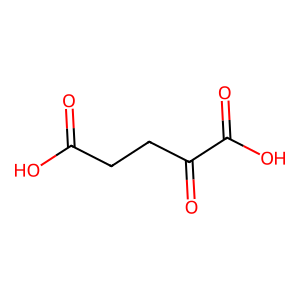
Dipotassium oxoglurate
CAS No.:
997-43-3
M. Wt:
184.18800
M. Fa:
C5H5KO5
InChI Key:
KPGXRSRHYNQIFN-UHFFFAOYSA-N
Appearance:
White powder
Names and Identifiers of Dipotassium oxoglurate
CAS Number |
997-43-3 |
|---|---|
EC Number |
206-330-3 |
IUPAC Name |
2-oxopentanedioic acid |
InChI |
InChI=1S/C5H6O5/c6-3(5(9)10)1-2-4(7)8/h1-2H2,(H,7,8)(H,9,10) |
InChIKey |
KPGXRSRHYNQIFN-UHFFFAOYSA-N |
Canonical SMILES |
C(CC(=O)O)C(=O)C(=O)O |
UNII |
8ID597Z82X |
Physical and chemical properties of Dipotassium oxoglurate
Exact Mass |
183.97700 |
|---|---|
Melting Point |
115.5 °C |
Molecular Formula |
C5H5KO5 |
Molecular Weight |
184.18800 |
PSA |
94.50000 |
Solubility |
soluble in water at >1000 g/l at 20°C and petrolatum at <100 g/kg at 20°C |
Storage condition |
2-8°C |
Safety Information of Dipotassium oxoglurate

Applications of Dipotassium oxoglurate
Potassium 4-carboxy-2-oxobutanoate has diverse applications across various fields:
- Biochemistry: It is utilized in studies related to metabolic pathways and enzyme interactions.
- Medicine: Potential therapeutic effects are being explored, particularly in calcium supplementation and metabolic disorders.
- Industry: It serves as a precursor for synthesizing biodegradable polymers and acts as a chelating agent.
Interaction Studies of Dipotassium oxoglurate
Studies on potassium 4-carboxy-2-oxobutanoate have revealed its interactions with several biological molecules:
- Enzymatic Interactions: It acts as a co-substrate for 2-oxoglutarate-dependent dioxygenases, which are involved in hydroxylation reactions critical for various biosynthetic pathways.
- Cellular Signaling: The compound participates in signaling pathways by modulating enzyme activity related to metabolism and energy production.
Biological Activity of Dipotassium oxoglurate
Potassium 4-carboxy-2-oxobutanoate is involved in critical biochemical pathways:
- Energy Metabolism: It serves as an intermediate in the Krebs cycle, contributing to the conversion of carbohydrates, fats, and proteins into usable energy forms.
- Gene Regulation: The compound influences gene expression and acts as a signaling molecule in various cellular processes.
- Protective Effects: Research indicates that it may provide protective effects against oxidative stress in various organisms.
Physical sample testing spectrum (NMR) of Dipotassium oxoglurate
