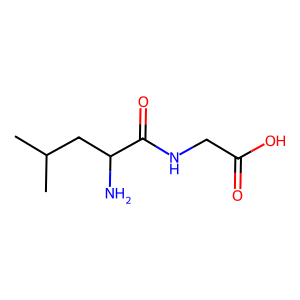
D-Leu-Gly
CAS No.:
997-05-7
M. Wt:
188.22400
M. Fa:
C8H16N2O3
InChI Key:
LESXFEZIFXFIQR-ZCFIWIBFSA-N
Appearance:
White Solid
Names and Identifiers of D-Leu-Gly
CAS Number |
997-05-7 |
|---|---|
IUPAC Name |
2-[[(2R)-2-amino-4-methylpentanoyl]amino]acetic acid |
InChI |
InChI=1S/C8H16N2O3/c1-5(2)3-6(9)8(13)10-4-7(11)12/h5-6H,3-4,9H2,1-2H3,(H,10,13)(H,11,12)/t6-/m1/s1 |
InChIKey |
LESXFEZIFXFIQR-ZCFIWIBFSA-N |
Canonical SMILES |
CC(C)CC(C(=O)NCC(=O)O)N |
Isomeric SMILES |
CC(C)C[C@H](C(=O)NCC(=O)O)N |
Physical and chemical properties of D-Leu-Gly
Boiling Point |
410.4ºC at 760mmHg |
|---|---|
Density |
1.136g/cm3 |
Exact Mass |
188.11600 |
Flash Point |
202ºC |
Index of Refraction |
1.488 |
LogP |
0.65180 |
Molecular Formula |
C8H16N2O3 |
Molecular Weight |
188.22400 |
PSA |
92.42000 |
Storage condition |
−20°C |
Applications of D-Leu-Gly
D-Leu-Gly finds applications in various fields:
- Food Industry: Due to its bitter taste profile, it may be used as a flavoring agent or in taste modulation.
- Pharmaceuticals: Its potential biological activities make it a candidate for drug development, particularly in areas related to metabolism and immune function.
- Research: It serves as a model compound for studying peptide behavior and interactions in biochemical research.
Interaction Studies of D-Leu-Gly
Interaction studies involving D-Leu-Gly often focus on its binding properties and effects on biological systems. For example, investigations into how this dipeptide interacts with receptors or enzymes could reveal insights into its role in metabolic regulation. Additionally, studies examining its bitterness may provide information on how it interacts with taste receptors.
Physical sample testing spectrum (NMR) of D-Leu-Gly

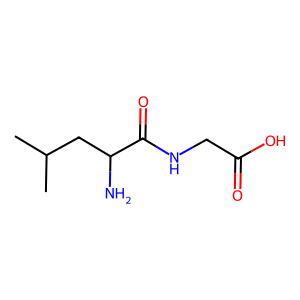 Cas:615-82-7

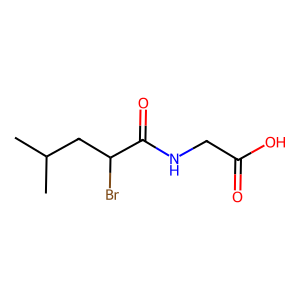 Cas:7154-27-0
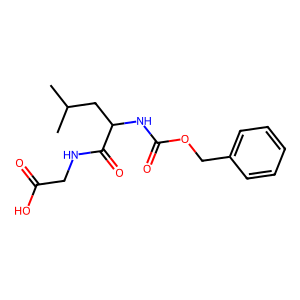 Cas:2706-38-9