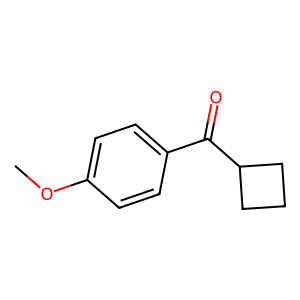
Cyclobutyl 4-methoxyphenyl ketone
Names and Identifiers of Cyclobutyl 4-methoxyphenyl ketone
CAS Number |
100121-80-0 |
|---|---|
MDL Number |
MFCD03841250 |
IUPAC Name |
cyclobutyl-(4-methoxyphenyl)methanone |
InChI |
InChI=1S/C12H14O2/c1-14-11-7-5-10(6-8-11)12(13)9-3-2-4-9/h5-9H,2-4H2,1H3 |
InChIKey |
ZFYOOJLCJQTVHL-UHFFFAOYSA-N |
Canonical SMILES |
COC1=CC=C(C=C1)C(=O)C2CCC2 |
UNSPSC Code |
12352100 |
Physical and chemical properties of Cyclobutyl 4-methoxyphenyl ketone
Boiling Point |
320.3ºC at 760 mmHg |
|---|---|
Density |
1.106g/cm3 |
Exact Mass |
190.09900 |
Flash Point |
145.4ºC |
Index of Refraction |
1.549 |
LogP |
2.67800 |
Molecular Formula |
C12H14O2 |
Molecular Weight |
190.23800 |
PSA |
26.30000 |
Vapour Pressure |
0.00032mmHg at 25°C |
Safety Information of Cyclobutyl 4-methoxyphenyl ketone

Applications of Cyclobutyl 4-methoxyphenyl ketone
Cyclobutyl 4-methoxyphenyl ketone has diverse applications across various fields:
- Chemistry: Serves as a building block in organic synthesis and as a reagent in cycloaddition reactions.
- Biology: Investigated for potential biological activity and interactions with biomolecules.
- Medicine: Explored for use in drug development and as an intermediate in synthesizing pharmaceutical compounds.
- Industry: Utilized in producing advanced materials and as a catalyst in various chemical processes .
Interaction Studies of Cyclobutyl 4-methoxyphenyl ketone
Studies on the interactions of cyclobutyl 4-methoxyphenyl ketone with biomolecules are ongoing. These investigations aim to elucidate its mechanism of action, particularly how it influences specific molecular targets and pathways within biological systems. Understanding these interactions could pave the way for potential therapeutic applications .
Biological Activity of Cyclobutyl 4-methoxyphenyl ketone
Research into the biological activity of cyclobutyl 4-methoxyphenyl ketone indicates potential interactions with biomolecules, which may lead to applications in medicinal chemistry. Although specific biological effects are still under investigation, the compound's structure suggests it could interact with various biological targets, potentially influencing metabolic pathways or exhibiting pharmacological properties .