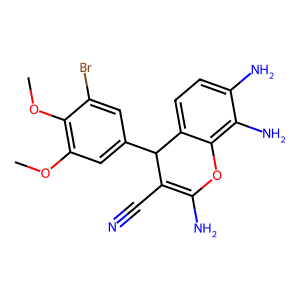
Crolibulin
Names and Identifiers of Crolibulin
CAS Number |
1000852-17-4 |
|---|---|
IUPAC Name |
(4R)-2,7,8-triamino-4-(3-bromo-4,5-dimethoxyphenyl)-4H-chromene-3-carbonitrile |
InChI |
InChI=1S/C18H17BrN4O3/c1-24-13-6-8(5-11(19)17(13)25-2)14-9-3-4-12(21)15(22)16(9)26-18(23)10(14)7-20/h3-6,14H,21-23H2,1-2H3/t14-/m1/s1 |
InChIKey |
JXONINOYTKKXQQ-CQSZACIVSA-N |
Canonical SMILES |
COC1=C(C(=CC(=C1)C2C3=C(C(=C(C=C3)N)N)OC(=C2C#N)N)Br)OC |
Isomeric SMILES |
COC1=C(C(=CC(=C1)[C@@H]2C3=C(C(=C(C=C3)N)N)OC(=C2C#N)N)Br)OC |
UNII |
9ENT43KY91 |
Physical and chemical properties of Crolibulin
Acidity coefficient |
3.59±0.70(Predicted) |
|---|---|
Boiling Point |
604.2±55.0 °C(Predicted) |
Density |
1.62±0.1 g/cm3(Predicted) |
Exact Mass |
416.04800 |
LogP |
4.71158 |
Molecular Formula |
C18H17BrN4O3 |
Molecular Weight |
417.25700 |
PSA |
129.54000 |
Storage condition |
2-8℃ |
Applications of Crolibulin
Crolibulin has been primarily investigated for its applications in oncology as a treatment for various solid tumors. It is currently undergoing Phase I/II clinical trials to evaluate its safety and efficacy in patients with advanced cancers resistant to standard treatments. Its unique mechanism of action as a vascular disrupting agent makes it a candidate for combination therapies with other anticancer drugs such as cisplatin. Additionally, research suggests potential applications in treating other conditions where microtubule stabilization is beneficial.
Interaction Studies of Crolibulin
Studies have shown that crolibulin interacts specifically with β-tubulin at the colchicine binding site. This interaction has been characterized using molecular docking studies that reveal how crolibulin mimics the binding properties of colchicine, leading to similar biological outcomes such as microtubule depolymerization and disruption of cellular structures necessary for mitosis. Furthermore, imaging studies have demonstrated changes in tumor perfusion and vascular structure post-treatment with crolibulin, indicating its effects on tumor vasculature.
Biological Activity of Crolibulin
Crolibulin exhibits significant biological activity against various cancer cell lines by inducing apoptosis and inhibiting cell proliferation. In preclinical studies, it has been demonstrated to effectively reduce tumor growth and induce mitotic arrest in triple-negative breast cancer cells. The compound's efficacy is attributed to its ability to disrupt microtubule dynamics and alter the tumor vasculature, leading to reduced blood supply and increased tumor cell death. Clinical trials have indicated that crolibulin can enhance the effects of other chemotherapeutics when used in combination therapy.