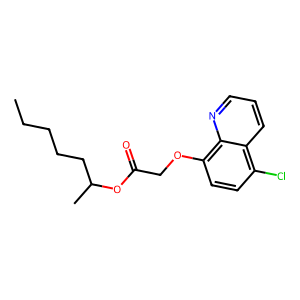
Cloquintocet-mexyl
Names and Identifiers of Cloquintocet-mexyl
CAS Number |
99607-70-2 |
|---|---|
EC Number |
619-447-3 |
MDL Number |
MFCD01632329 |
IUPAC Name |
heptan-2-yl 2-(5-chloroquinolin-8-yl)oxyacetate |
InChI |
InChI=1S/C18H22ClNO3/c1-3-4-5-7-13(2)23-17(21)12-22-16-10-9-15(19)14-8-6-11-20-18(14)16/h6,8-11,13H,3-5,7,12H2,1-2H3 |
InChIKey |
COYBRKAVBMYYSF-UHFFFAOYSA-N |
Canonical SMILES |
CCCCCC(C)OC(=O)COC1=C2C(=C(C=C1)Cl)C=CC=N2 |
UNII |
99W15EH2M3 |
UNSPSC Code |
12352100 |
Physical and chemical properties of Cloquintocet-mexyl
Acidity coefficient |
1.94±0.29(Predicted) |
|---|---|
Boiling Point |
448.4±30.0 °C at 760 mmHg |
Density |
1.2±0.1 g/cm3 |
Dissociation constant |
3.55 at 20℃ |
Exact Mass |
335.128815 |
Flash Point |
225.0±24.6 °C |
Index of Refraction |
1.554 |
LogP |
5.01 |
Melting Point |
70 °C |
Merck |
14,2401 |
Molecular Formula |
C18H22ClNO3 |
Molecular Weight |
335.825 |
PSA |
48.42000 |
Solubility |
Chloroform (Slightly), DMSO (Slightly), Ethyl Acetate (Slightly) |
Stability |
Stable. Incompatible with strong oxidizing agents. |
Storage condition |
0-6°C |
surface tension |
56.8-57.2mN/m at 590μg/L and 20℃ |
Vapour Pressure |
0.0±1.1 mmHg at 25°C |
Solubility of Cloquintocet-mexyl
| Solvent | Dissolution Behavior | Temperature Effect | pH Effect |
|---|---|---|---|
| Water | Soluble, forms a clear solution | Solubility increases with rising temperature | Stable under neutral to weakly acidic conditions; prone to hydrolysis and reduced solubility under alkaline conditions |
| Ethanol | Soluble, forms a clear solution | Heating improves dissolution rate and extent | Stable under acidic or neutral conditions; decomposes under strong alkaline conditions, reducing solubility |
| Acetone | Freely soluble | Increased temperature promotes dissolution | Good stability, but may degrade under high pH conditions |
| Diethyl ether | Slightly soluble | Slight improvement with increased temperature | Sensitive to acids and bases; unstable under extreme pH conditions |
| Toluene | Practically insoluble | No significant effect | Not applicable (due to near insolubility) |
| Chloroform | Soluble | Heating increases solubility | Stable under neutral conditions; may decompose under strong alkaline conditions |
| Dimethyl sulfoxide (DMSO) | Highly soluble | Higher temperatures facilitate complete dissolution | Stable over a wide pH range; one of the commonly used solvents |
Safety Information of Cloquintocet-mexyl


Key Milestone of Cloquintocet-mexyl
| Time | Event | Description |
|---|---|---|
| Early 1960s | Initial Synthesis and Discovery | Dichlormid was synthesized by Monsanto (USA) during the development of selective herbicides and was initially identified as a potential pesticide intermediate. |
| 1967 | Function as a Safener Confirmed | Research found that Dichlormid significantly reduced crop injury from chloroacetamide herbicides (e.g., acetochlor, alachlor) in crops like corn, enhancing crop tolerance without compromising weed control efficacy. |
| 1970s | Commercial Application Launched | Dichlormid began to be used commercially as a herbicide safener, formulated with herbicides like acetochlor, and was applied in US corn fields under trade names such as "Dichlormid" or as a component in formulated mixtures. |
| 1980s | Global Registration and Promotion | Dichlormid obtained pesticide registration in multiple countries (e.g., Canada, some European nations) and was widely used in corn, sorghum, and other gramineous crops to improve herbicide application safety. |
| 1990s | In-depth Mechanism of Action Research | Scientists elucidated its mechanism: inducing detoxifying enzyme systems (e.g., glutathione S-transferase, GST) in crops to accelerate herbicide metabolism, thereby protecting the plants. |
| 2000s onwards | Stable Application, Strengthened Regulation | Although still in use, some countries imposed restrictions due to enhanced environmental and toxicological assessments; it remained a classic case study for safeners in pesticide synergy research. |
| 2010s to present | Coexistence of Alternative Development and Continued Use | New safeners continue to emerge, but Dichlormid maintains a market share in some developing countries due to its low cost and proven effectiveness; it is also used as a research model for exploring safener mechanisms. |
Applications of Cloquintocet-mexyl
Cloquintocet-mexyl is primarily utilized in agriculture as a safener for various herbicides, particularly those that may otherwise harm crops. Its application helps mitigate phytotoxic effects while allowing farmers to control weed populations effectively. It has been used alongside herbicides like clodinafop-propargyl and fenoxaprop-P-ethyl, enhancing crop safety during treatment. Additionally, it has potential applications in environmental management due to its low toxicity profile.
Interaction Studies of Cloquintocet-mexyl
Interaction studies involving cloquintocet-mexyl have demonstrated its ability to enhance the efficacy of co-applied herbicides while minimizing crop damage. Research indicates that it can alter the absorption and metabolism of these herbicides within plant systems, promoting safer agricultural practices. Moreover, studies on its environmental interactions reveal that it degrades rapidly in soil conditions, reducing long-term ecological impact.
Biological Activity of Cloquintocet-mexyl
The biological activity of cloquintocet-mexyl is primarily linked to its role as a herbicide safener. It exhibits low acute toxicity levels across various exposure routes—oral, dermal, and inhalation—making it relatively safe for use in agricultural settings. Studies indicate that it does not cause significant skin irritation but may provoke allergic reactions in sensitive individuals. Furthermore, cloquintocet-mexyl has been shown to induce protective responses in crops against herbicide-induced stress, which is vital for crop yield and health.
Physical sample testing spectrum (NMR) of Cloquintocet-mexyl

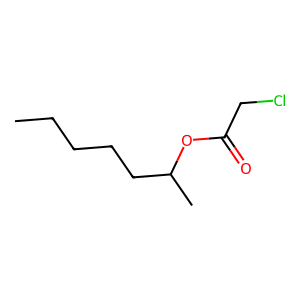 Cas:383412-05-3

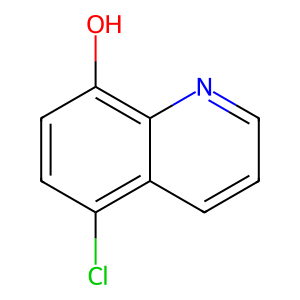 Cas:130-16-5
