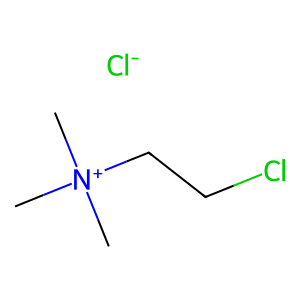
Chlormequat chloride
Names and Identifiers of Chlormequat chloride
CAS Number |
999-81-5 |
|---|---|
EC Number |
213-666-4 |
MDL Number |
MFCD00011869 |
IUPAC Name |
2-chloroethyl(trimethyl)azanium;chloride |
InChI |
InChI=1S/C5H13ClN.ClH/c1-7(2,3)5-4-6;/h4-5H2,1-3H3;1H/q+1;/p-1 |
InChIKey |
UHZZMRAGKVHANO-UHFFFAOYSA-M |
Canonical SMILES |
C[N+](C)(C)CCCl.[Cl-] |
UNII |
PPL2215L82 |
UNSPSC Code |
12352100 |
Physical and chemical properties of Chlormequat chloride
Boiling Point |
260.3°C (rough estimate) |
|---|---|
BRN |
3563994 |
Decomposition |
245 °C |
Density |
1.14 to 1.15 g/mL at 20 °C |
Exact Mass |
157.042511 |
Index of Refraction |
1.5500 (estimate) |
LogP |
log Kow = -3.80 |
Melting Point |
239 °C (decomposes) |
Merck |
14,2104 |
Molecular Formula |
C5H13Cl2N |
Molecular Weight |
158.069 |
Odor |
Fish-like odor |
pH |
pH = 5.14 |
Sensitivity |
Hygroscopic |
Stability |
Stable. Combustible. Incompatible with strong oxidizing agents. Corrodes many metals. Very hygroscopic. |
Storage condition |
Inert atmosphere,Room Temperature |
Vapour Pressure |
Vapor pressure at 20 °C: negligible |
Water Solubility |
almost transparency |
Solubility of Chlormequat chloride
| Solvent | Dissolution Behavior | Temperature Effect | pH Effect |
|---|---|---|---|
| Water | Readily soluble, forming a clear solution | Solubility slightly increases with rising temperature | Stable under neutral to weakly acidic conditions; prone to hydrolysis and degradation in alkaline conditions |
| Ethanol | Soluble, but with lower solubility | Solubility increases with rising temperature | Relatively stable under acidic or neutral conditions; unstable under strongly alkaline conditions |
| Acetone | Readily soluble | Solubility increases with rising temperature | Good stability; unaffected by common pH ranges |
| Methanol | Readily soluble | Solubility increases with rising temperature | Good stability; insensitive to pH changes |
| Ethyl acetate | Slightly soluble | Solubility slightly improves with rising temperature | Stable under acidic conditions; may decompose under alkaline conditions |
| Chloroform | Slightly soluble | Solubility slightly increases with rising temperature | Insensitive to pH changes; however, requires protection from light during long-term storage |
| Dichloromethane | Slightly soluble | Solubility slightly improves with rising temperature | Good stability; insensitive to pH changes |
Safety Information of Chlormequat chloride

Key Milestone of Chlormequat chloride
| Year | Event | Description |
|---|---|---|
| 1957 | First Synthesis and Discovery of Plant Growth Regulation | Scientists at the American Cyanamid Company first synthesized chlormequat chloride and discovered its ability to inhibit stem elongation and promote plant dwarfing. |
| 1958–1960 | Early Agricultural Trials and Mechanism Research | Field trials on cereal crops like wheat and barley confirmed its effectiveness in preventing lodging and improving stress resistance; preliminary research revealed it regulates plant growth by inhibiting gibberellin biosynthesis. |
| Early 1960s | First Commercial Application | Chlormequat was approved as a plant growth regulator in the United States and Europe for use on cereal crops (e.g., wheat, barley), becoming the first widely used anti-lodging agent. |
| 1960s–1970s | Global Expansion and Crop Diversification | Its use was promoted globally and gradually extended to crops such as cotton, corn, rice, and ornamental flowers (e.g., chrysanthemums, tulips) for height control, improved plant structure, and increased yield. |
| 1970s–1980s | In-depth Mechanism of Action Studies | Scientists confirmed that chlormequat inhibits the enzyme ent-kaurene oxidase, thereby blocking gibberellin (GA) synthesis and suppressing cell elongation. |
| 1990s | Enhanced Environmental and Toxicological Assessment | With growing awareness of environmental and food safety issues, countries conducted stricter toxicological and environmental risk assessments for chlormequat; regions like the EU began establishing maximum residue limits. |
| 2000s | Regulatory Oversight and Usage Restrictions | The EU imposed restrictions on the use of chlormequat for certain crops (e.g., ornamental plants); countries like China continued to list it as a legal plant growth regulator but strengthened residue monitoring. |
| 2010s–Present | Development of Alternatives and Precision Application Techniques | Due to public concern over chemical regulators, research has focused on developing safer alternatives (e.g., novel gibberellin inhibitors); precision application techniques like foliar spraying and seed treatment have been developed to reduce usage. |
Applications of Chlormequat chloride
Chlormequat chloride is primarily utilized in agriculture as a plant growth regulator. Its applications include:
- Cereal Grains: Enhancing yield by controlling plant height and improving resistance to lodging.
- Vegetables: Used on crops like tomatoes and peppers to promote compact growth.
- Ornamental Plants: Helps in maintaining desired shapes and sizes for aesthetic purposes.
Additionally, it has been studied for potential uses in other areas such as turf management and horticulture.
Interaction Studies of Chlormequat chloride
Research on chlormequat chloride interactions indicates that it may have significant effects on human health through environmental exposure. Studies have shown its presence in food products and urine samples from various populations, highlighting its bioaccumulation potential. The compound's interaction with biological systems may lead to alterations in steroid biosynthesis and stress responses within cells. Further investigation into its long-term health effects is warranted due to its widespread use and detection in food supplies.
Physical sample testing spectrum (NMR) of Chlormequat chloride

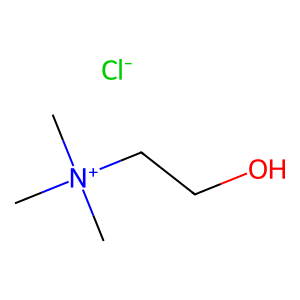 Cas:67-48-1


 Cas:98-09-9
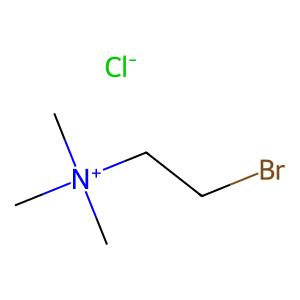 Cas:42350-92-5