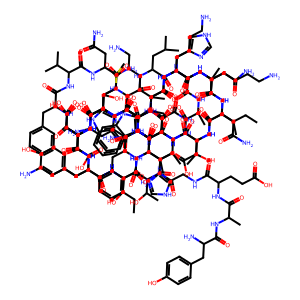
CID 90488736
CAS No.:
100040-31-1
M. Wt:
4983.53
M. Fa:
C226H338N60O66S
InChI Key:
MGXWVYUBJRZYPE-YUGYIWNOSA-N
Appearance:
White to Off-White Solid
Names and Identifiers of CID 90488736
CAS Number |
100040-31-1 |
|---|---|
IUPAC Name |
(2S)-5-amino-2-[[(2S,3R)-2-[[(2S,3S)-2-[[(2S)-4-amino-2-[[(2S)-2-[[(2S)-6-amino-2-[[(2S)-2-[[(2S)-2-[[(2S)-4-amino-2-[[(2S)-6-amino-2-[[(2S)-6-amino-2-[[2-[[(2S)-6-amino-2-[[(2S)-5-amino-2-[[(2S)-2-[[(2S)-2-[[(2S)-2-[[(2S)-2-[[(2S)-4-amino-2-[[(2S)-2-[[(2S)-2-[[(2S)-2-[[(2S)-5-amino-2-[[(2S)-5-amino-2-[[(2S)-2-[[(2S,3S)-2-[[(2S)-6-amino-2-[[(2S)-2-[[(2S)-2-[[(2S)-2-[[(2S,3S)-2-[[(2S)-2-[[(2S)-2-[[(2S)-2-[[(2S)-2-[[(2S,3S)-2-[[(2S)-2-[[(2S,3R)-2-[[2-[[(2S)-2-[[(2S)-2-[[(2S)-2-amino-3-(4-hydroxyphenyl)propanoyl]amino]propanoyl]amino]-4-carboxybutanoyl]amino]acetyl]amino]-3-hydroxybutanoyl]amino]-3-phenylpropanoyl]amino]-3-methylpentanoyl]amino]-3-hydroxypropanoyl]amino]-3-carboxypropanoyl]amino]-3-(4-hydroxyphenyl)propanoyl]amino]-3-hydroxypropanoyl]amino]-3-methylpentanoyl]amino]propanoyl]amino]-4-methylsulfanylbutanoyl]amino]-3-carboxypropanoyl]amino]hexanoyl]amino]-3-methylpentanoyl]amino]-3-(1H-imidazol-4-yl)propanoyl]amino]-5-oxopentanoyl]amino]-5-oxopentanoyl]amino]-3-carboxypropanoyl]amino]-3-phenylpropanoyl]amino]-3-methylbutanoyl]amino]-4-oxobutanoyl]amino]-3-(1H-indol-3-yl)propanoyl]amino]-4-methylpentanoyl]amino]-4-methylpentanoyl]amino]propanoyl]amino]-5-oxopentanoyl]amino]hexanoyl]amino]acetyl]amino]hexanoyl]amino]hexanoyl]amino]-4-oxobutanoyl]amino]-3-carboxypropanoyl]amino]-3-(1H-indol-3-yl)propanoyl]amino]hexanoyl]amino]-3-(1H-imidazol-4-yl)propanoyl]amino]-4-oxobutanoyl]amino]-3-methylpentanoyl]amino]-3-hydroxybutanoyl]amino]-5-oxopentanoic acid |
InChI |
InChI=1S/C226H338N60O66S/c1-21-113(11)181(285-218(343)165(107-288)278-203(328)150(88-125-60-64-131(292)65-61-125)264-212(337)163(99-179(310)311)274-217(342)164(106-287)279-222(347)183(115(13)23-3)283-215(340)152(87-123-47-29-26-30-48-123)275-224(349)185(120(18)289)280-174(301)105-245-192(317)142(70-75-175(302)303)252-187(312)117(15)248-190(315)134(232)85-124-58-62-130(291)63-59-124)220(345)250-119(17)189(314)254-146(76-82-353-20)199(324)272-160(96-176(304)305)210(335)258-141(57-39-44-81-231)200(325)282-182(114(12)22-2)221(346)276-156(92-129-103-241-109-247-129)206(331)260-144(67-72-167(234)294)197(322)259-145(68-73-168(235)295)198(323)271-161(97-177(306)307)211(336)265-151(86-122-45-27-25-28-46-122)214(339)281-180(112(9)10)219(344)277-158(94-171(238)298)209(334)266-154(90-127-101-243-136-52-34-32-50-133(127)136)205(330)263-149(84-111(7)8)202(327)262-148(83-110(5)6)201(326)249-118(16)188(313)253-143(66-71-166(233)293)196(321)255-137(53-35-40-77-227)191(316)244-104-173(300)251-138(54-36-41-78-228)193(318)256-139(55-37-42-79-229)195(320)269-157(93-170(237)297)208(333)273-162(98-178(308)309)213(338)267-153(89-126-100-242-135-51-33-31-49-132(126)135)204(329)257-140(56-38-43-80-230)194(319)268-155(91-128-102-240-108-246-128)207(332)270-159(95-172(239)299)216(341)284-184(116(14)24-4)223(348)286-186(121(19)290)225(350)261-147(226(351)352)69-74-169(236)296/h25-34,45-52,58-65,100-103,108-121,134,137-165,180-186,242-243,287-292H,21-24,35-44,53-57,66-99,104-107,227-232H2,1-20H3,(H2,233,293)(H2,234,294)(H2,235,295)(H2,236,296)(H2,237,297)(H2,238,298)(H2,239,299)(H,240,246)(H,241,247)(H,244,316)(H,245,317)(H,248,315)(H,249,326)(H,250,345)(H,251,300)(H,252,312)(H,253,313)(H,254,314)(H,255,321)(H,256,318)(H,257,329)(H,258,335)(H,259,322)(H,260,331)(H,261,350)(H,262,327)(H,263,330)(H,264,337)(H,265,336)(H,266,334)(H,267,338)(H,268,319)(H,269,320)(H,270,332)(H,271,323)(H,272,324)(H,273,333)(H,274,342)(H,275,349)(H,276,346)(H,277,344)(H,278,328)(H,279,347)(H,280,301)(H,281,339)(H,282,325)(H,283,340)(H,284,341)(H,285,343)(H,286,348)(H,302,303)(H,304,305)(H,306,307)(H,308,309)(H,310,311)(H,351,352)/t113-,114-,115-,116-,117-,118-,119-,120+,121+,134-,137-,138-,139-,140-,141-,142-,143-,144-,145-,146-,147-,148-,149-,150-,151-,152-,153-,154-,155-,156-,157-,158-,159-,160-,161-,162-,163-,164-,165-,180-,181-,182-,183-,184-,185-,186-/m0/s1 |
InChIKey |
MGXWVYUBJRZYPE-YUGYIWNOSA-N |
Canonical SMILES |
CCC(C)C(C(=O)NC(CC1=CNC=N1)C(=O)NC(CCC(=O)N)C(=O)NC(CCC(=O)N)C(=O)NC(CC(=O)O)C(=O)NC(CC2=CC=CC=C2)C(=O)NC(C(C)C)C(=O)NC(CC(=O)N)C(=O)NC(CC3=CNC4=CC=CC=C43)C(=O)NC(CC(C)C)C(=O)NC(CC(C)C)C(=O)NC(C)C(=O)NC(CCC(=O)N)C(=O)NC(CCCCN)C(=O)NCC(=O)NC(CCCCN)C(=O)NC(CCCCN)C(=O)NC(CC(=O)N)C(=O)NC(CC(=O)O)C(=O)NC(CC5=CNC6=CC=CC=C65)C(=O)NC(CCCCN)C(=O)NC(CC7=CNC=N7)C(=O)NC(CC(=O)N)C(=O)NC(C(C)CC)C(=O)NC(C(C)O)C(=O)NC(CCC(=O)N)C(=O)O)NC(=O)C(CCCCN)NC(=O)C(CC(=O)O)NC(=O)C(CCSC)NC(=O)C(C)NC(=O)C(C(C)CC)NC(=O)C(CO)NC(=O)C(CC8=CC=C(C=C8)O)NC(=O)C(CC(=O)O)NC(=O)C(CO)NC(=O)C(C(C)CC)NC(=O)C(CC9=CC=CC=C9)NC(=O)C(C(C)O)NC(=O)CNC(=O)C(CCC(=O)O)NC(=O)C(C)NC(=O)C(CC1=CC=C(C=C1)O)N |
Isomeric SMILES |
CC[C@H](C)[C@@H](C(=O)N[C@@H](CC1=CNC=N1)C(=O)N[C@@H](CCC(=O)N)C(=O)N[C@@H](CCC(=O)N)C(=O)N[C@@H](CC(=O)O)C(=O)N[C@@H](CC2=CC=CC=C2)C(=O)N[C@@H](C(C)C)C(=O)N[C@@H](CC(=O)N)C(=O)N[C@@H](CC3=CNC4=CC=CC=C43)C(=O)N[C@@H](CC(C)C)C(=O)N[C@@H](CC(C)C)C(=O)N[C@@H](C)C(=O)N[C@@H](CCC(=O)N)C(=O)N[C@@H](CCCCN)C(=O)NCC(=O)N[C@@H](CCCCN)C(=O)N[C@@H](CCCCN)C(=O)N[C@@H](CC(=O)N)C(=O)N[C@@H](CC(=O)O)C(=O)N[C@@H](CC5=CNC6=CC=CC=C65)C(=O)N[C@@H](CCCCN)C(=O)N[C@@H](CC7=CNC=N7)C(=O)N[C@@H](CC(=O)N)C(=O)N[C@@H]([C@@H](C)CC)C(=O)N[C@@H]([C@@H](C)O)C(=O)N[C@@H](CCC(=O)N)C(=O)O)NC(=O)[C@H](CCCCN)NC(=O)[C@H](CC(=O)O)NC(=O)[C@H](CCSC)NC(=O)[C@H](C)NC(=O)[C@H]([C@@H](C)CC)NC(=O)[C@H](CO)NC(=O)[C@H](CC8=CC=C(C=C8)O)NC(=O)[C@H](CC(=O)O)NC(=O)[C@H](CO)NC(=O)[C@H]([C@@H](C)CC)NC(=O)[C@H](CC9=CC=CC=C9)NC(=O)[C@H]([C@@H](C)O)NC(=O)CNC(=O)[C@H](CCC(=O)O)NC(=O)[C@H](C)NC(=O)[C@H](CC1=CC=C(C=C1)O)N |
Physical and chemical properties of CID 90488736
Molecular Formula |
C226H338N60O66S |
|---|---|
Molecular Weight |
4983.53 |
Storage condition |
-20°C |
Solubility of CID 90488736
| Solvent | Solubility Behavior | Effect of Temperature | Effect of pH |
|---|---|---|---|
| Water | Readily soluble | Solubility slightly increases with rising temperature | Most stable at neutral pH (6–8); degrades under acidic conditions |
| Physiological saline | Soluble | Minor increase in solubility with elevated temperature | Minimal sensitivity to pH changes; suitable for injection |
| Dilute acid solution | Soluble, but prone to hydrolysis | High temperature accelerates hydrolysis | Highly acidic conditions cause degradation; unstable after dissolution |
| Dilute alkaline solution | Slightly soluble to soluble | Solubility increases with rising temperature | Strongly alkaline conditions may cause peptide chain degradation |
| Ethanol | Slightly soluble | Slight increase in solubility with rising temperature | Minimal pH effect; poor solubility overall |
| DMSO | Soluble | Increased temperature enhances dissolution rate | Minimal effect of pH changes on solubility |
Key Milestone of CID 90488736
| Year | Event | Description |
|---|---|---|
| 1930 | First Discovery | It was named "Gastric Inhibitory Polypeptide" (GIP), as it was initially observed to inhibit gastric acid secretion and gastric motility. It was first described by Perley and Chance in dog experiments. |
| 1960s–1970s | Structural Identification | Scientists isolated and determined the amino acid sequence of GIP, confirming it as a 42-amino-acid peptide hormone secreted by K cells in the small intestine. |
| 1970s | Re-evaluation of Function | Research found that GIP significantly increases after oral glucose intake and stimulates insulin release from pancreatic β-cells, leading to its reclassification as one of the incretins, alongside GLP-1. |
| 1980s–1990s | Receptor and Mechanism Studies | The GIP receptor (GIPR) was cloned, confirming it as a G-protein-coupled receptor primarily expressed in pancreatic β-cells and adipose tissue, elucidating its role in glucose homeostasis and lipid metabolism. |
| 2000s | Link to Type 2 Diabetes | Studies found that type 2 diabetes patients exhibit resistance to GIP's insulinotropic effects, but GIP may still play a role in lipid metabolism and bone metabolism, prompting renewed evaluation of its therapeutic potential. |
| 2010s | Development of Dual/Triple Receptor Agonists | With the success of GLP-1 receptor agonists (such as liraglutide and semaglutide), scientists began exploring dual GIP/GLP-1 receptor agonists (such as tirzepatide) for synergistic effects. |
| 2022 | Tirzepatide Approved | The U.S. FDA approved tirzepatide (Tirzepatide, marketed as Mounjaro®), a dual GIP/GLP-1 receptor agonist developed by Eli Lilly, for the treatment of type 2 diabetes, showing significant superiority over single GLP-1 agonists, marking GIP's transformation from an "overlooked incretin" to a therapeutic target. |
| 2023–2024 | Expanded Indications and Deepened Mechanisms | Tirzepatide was approved for obesity treatment (marketed as Zepbound®). Multiple studies further revealed GIP's potential roles in energy balance, adipose tissue metabolism, and neuroprotection, driving the development of next-generation multi-target incretin drugs. |
Applications of CID 90488736
GIP has several potential applications in medical and therapeutic contexts:
- Diabetes Management: Understanding GIP's role in insulin secretion can aid in developing therapies for type 2 diabetes.
- Obesity Treatment: Given its influence on appetite and fat accumulation, GIP may be targeted for obesity management strategies.
- Bone Health: Research into GIP's role in bone remodeling could lead to new treatments for osteoporosis and related conditions .
Interaction Studies of CID 90488736
Studies have shown that GIP interacts with various biological systems and receptors:
- Insulin Secretion: GIP enhances insulin release in response to oral glucose intake more effectively than intravenous administration.
- Glucagon Secretion: It also stimulates glucagon release from alpha cells in the pancreas, indicating a complex regulatory role in glucose metabolism.
- Central Nervous System: GIP's receptors are present in the brain, suggesting involvement in cognitive functions related to memory and appetite regulation .
Biological Activity of CID 90488736
GIP's biological activity extends beyond insulin secretion. It has been shown to:
- Inhibit apoptosis of pancreatic beta cells and promote their proliferation.
- Stimulate glucagon secretion.
- Influence appetite regulation and memory formation through actions in the central nervous system.
- Play a role in bone remodeling, with studies indicating that GIP receptor deficiency can adversely affect bone quality .
Notably, individuals with type 2 diabetes often exhibit diminished responses to GIP, which correlates with lower levels of GIP secretion post-meal compared to non-diabetics .