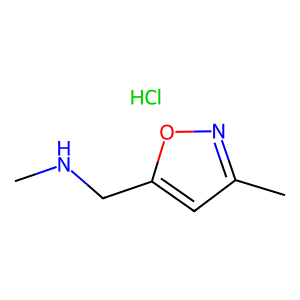
CHEMBRDG-BB 4100871
Names and Identifiers of CHEMBRDG-BB 4100871
CAS Number |
1000896-85-4 |
|---|---|
MDL Number |
MFCD11841325 |
IUPAC Name |
N-methyl-1-(3-methyl-1,2-oxazol-5-yl)methanamine;hydrochloride |
InChI |
InChI=1S/C6H10N2O.ClH/c1-5-3-6(4-7-2)9-8-5;/h3,7H,4H2,1-2H3;1H |
InChIKey |
LPAAQOUQIBYDMQ-UHFFFAOYSA-N |
Canonical SMILES |
CNCC1=CC(C)=NO1.Cl |
UNSPSC Code |
12352100 |
Physical and chemical properties of CHEMBRDG-BB 4100871
Exact Mass |
162.055984 |
|---|---|
Molecular Formula |
C6H10N2O |
Molecular Weight |
126.16 |
Safety Information of CHEMBRDG-BB 4100871

Applications of CHEMBRDG-BB 4100871
N-Methyl-1-(3-methyl-5-isoxazolyl)methanamine hydrochloride finds applications in several areas:
- Medicinal Chemistry: It serves as a scaffold for developing new pharmaceutical agents targeting various diseases.
- Chemical Research: Utilized as a building block in synthetic organic chemistry for creating complex molecules.
- Biological Studies: Investigated for its potential effects on neurotransmitter systems and other biological pathways.
Interaction Studies of CHEMBRDG-BB 4100871
Studies on N-Methyl-1-(3-methyl-5-isoxazolyl)methanamine hydrochloride's interactions with biological systems have shown that it may affect neurotransmitter receptors and enzymes involved in metabolic pathways. Its analogs are often screened for their binding affinities and functional effects on these targets, contributing to the understanding of their therapeutic potential.
Biological Activity of CHEMBRDG-BB 4100871
Research indicates that N-Methyl-1-(3-methyl-5-isoxazolyl)methanamine hydrochloride exhibits various biological activities, particularly in the realm of pharmacology. Its derivatives are investigated for potential applications in treating neurological disorders and other conditions due to their ability to interact with neurotransmitter systems. The compound's structure allows it to potentially act as a modulator of specific receptors, although detailed studies on its efficacy and mechanisms are still ongoing.