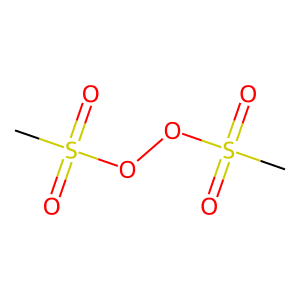
Bis(methylsulfonyl)peroxide
CAS No.:
1001-62-3
M. Wt:
190.19500
M. Fa:
C2H6O6S2
InChI Key:
XJPAEZVERBCSTJ-UHFFFAOYSA-N
Names and Identifiers of Bis(methylsulfonyl)peroxide
CAS Number |
1001-62-3 |
|---|---|
IUPAC Name |
methylsulfonyloxy methanesulfonate |
InChI |
InChI=1S/C2H6O6S2/c1-9(3,4)7-8-10(2,5)6/h1-2H3 |
InChIKey |
XJPAEZVERBCSTJ-UHFFFAOYSA-N |
Canonical SMILES |
CS(=O)(=O)OOS(=O)(=O)C |
Physical and chemical properties of Bis(methylsulfonyl)peroxide
Density |
1.545 (estimate) |
|---|---|
Exact Mass |
189.96100 |
Index of Refraction |
1.5630 (estimate) |
LogP |
1.01540 |
Molecular Formula |
C2H6O6S2 |
Molecular Weight |
190.19500 |
PSA |
103.50000 |
Vapour Pressure |
0.00666mmHg at 25°C |
Applications of Bis(methylsulfonyl)peroxide
Bis(methylsulfonyl)peroxide has several applications across various fields:
- Organic Synthesis: It is widely used as an oxidizing agent in organic chemistry for synthesizing complex molecules.
- Polymer Chemistry: The compound serves as a free radical initiator in polymerization processes, particularly in producing thermosetting plastics and elastomers.
- Pharmaceutical Industry: Its potential as an oxidant may find applications in drug development, particularly in synthesizing biologically active compounds.
Interaction Studies of Bis(methylsulfonyl)peroxide
Studies have shown that bis(methylsulfonyl)peroxide interacts with various biomolecules, influencing their activity through oxidative modifications. For instance, it can affect protein function by modifying cysteine residues through sulfenic acid formation. Additionally, its role in generating reactive oxygen species may have implications for cellular signaling pathways and stress responses.