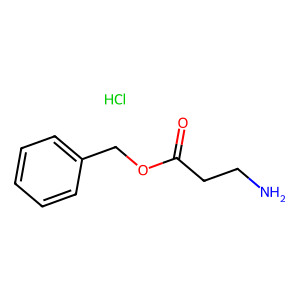
Benzyl 3-aminopropanoate hydrochloride
Names and Identifiers of Benzyl 3-aminopropanoate hydrochloride
CAS Number |
99616-43-0 |
|---|---|
EC Number |
852-473-5 |
MDL Number |
MFCD22378745 |
IUPAC Name |
benzyl 3-aminopropanoate;hydrochloride |
InChI |
InChI=1S/C10H13NO2.ClH/c11-7-6-10(12)13-8-9-4-2-1-3-5-9;/h1-5H,6-8,11H2;1H |
InChIKey |
QIBWNGWEFYSLCM-UHFFFAOYSA-N |
Canonical SMILES |
C1=CC=C(C=C1)COC(=O)CCN.Cl |
UNSPSC Code |
12352100 |
Physical and chemical properties of Benzyl 3-aminopropanoate hydrochloride
H Bond Acceptors |
2 |
|---|---|
H Bond Donors |
1 |
LogP |
0.959904352666666 |
Melting Point |
100-101 °C |
Molecular Formula |
C10H14ClNO2 |
Molecular Weight |
215.68 |
Safety Information of Benzyl 3-aminopropanoate hydrochloride

Applications of Benzyl 3-aminopropanoate hydrochloride
Benzyl 3-aminopropanoate hydrochloride has various applications, including:
- Pharmaceutical Development: As a cysteine prodrug, it is being explored for its potential use in treating neurodegenerative diseases and certain cancers due to its anti-apoptotic properties.
- Research Tool: It serves as a valuable reagent in biochemical research for studying amino acid metabolism and cellular signaling pathways.
- Chemical Intermediate: The compound can be used as an intermediate in synthesizing other biologically active compounds or pharmaceuticals.
Interaction Studies of Benzyl 3-aminopropanoate hydrochloride
Studies focusing on the interactions of Benzyl 3-aminopropanoate hydrochloride reveal its potential effects on cellular pathways related to apoptosis and cell survival. It has been shown to modulate various signaling pathways that are crucial for maintaining cellular homeostasis under stress conditions. Further research is needed to elucidate its precise mechanisms of action and potential interactions with other biochemical agents.
Biological Activity of Benzyl 3-aminopropanoate hydrochloride
Benzyl 3-aminopropanoate hydrochloride exhibits notable biological activities, primarily linked to its role as a cysteine prodrug. Research indicates that it possesses anti-apoptotic properties, meaning it can inhibit programmed cell death, which is significant in cancer therapy and neuroprotection. Additionally, studies have shown that this compound may enhance cellular survival under stress conditions, making it a candidate for further research in therapeutic applications.
Physical sample testing spectrum (NMR) of Benzyl 3-aminopropanoate hydrochloride

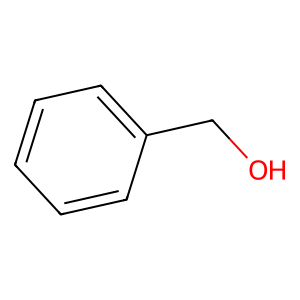 Cas:100-51-6

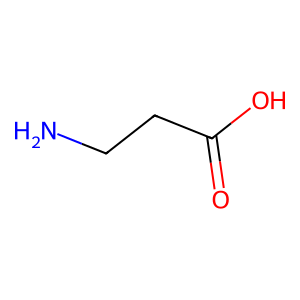 Cas:107-95-9
