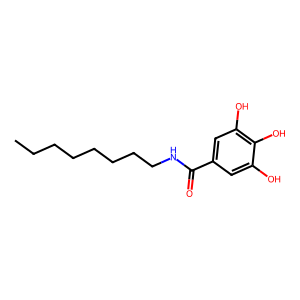
Benzamide, N-octyl-3,4,5-trihydroxy-
Names and Identifiers of Benzamide, N-octyl-3,4,5-trihydroxy-
CAS Number |
100079-24-1 |
|---|---|
IUPAC Name |
3,4,5-trihydroxy-N-octylbenzamide |
InChI |
InChI=1S/C15H23NO4/c1-2-3-4-5-6-7-8-16-15(20)11-9-12(17)14(19)13(18)10-11/h9-10,17-19H,2-8H2,1H3,(H,16,20) |
InChIKey |
QJLCSFQWKBLNGJ-UHFFFAOYSA-N |
Canonical SMILES |
CCCCCCCCNC(=O)C1=CC(=C(C(=C1)O)O)O |
Physical and chemical properties of Benzamide, N-octyl-3,4,5-trihydroxy-
Boiling Point |
445.7ºC at 760mmHg |
|---|---|
Density |
1.169g/cm3 |
Exact Mass |
281.16300 |
Flash Point |
223.4ºC |
Index of Refraction |
1.561 |
LogP |
3.28460 |
Molecular Formula |
C15H23NO4 |
Molecular Weight |
281.34700 |
PSA |
89.79000 |
Vapour Pressure |
1.47E-08mmHg at 25°C |
Applications of Benzamide, N-octyl-3,4,5-trihydroxy-
3,4,5-trihydroxy-N-octylbenzamide has potential applications in various fields:
- Pharmaceuticals: Its anticancer properties make it a candidate for drug development aimed at treating specific types of cancer.
- Cosmetics: The antioxidant properties may allow its use in skincare formulations to protect against oxidative damage.
- Agriculture: Research into its antimicrobial properties could lead to applications in agricultural biocides or preservatives.
Interaction Studies of Benzamide, N-octyl-3,4,5-trihydroxy-
Interaction studies involving 3,4,5-trihydroxy-N-octylbenzamide focus on its binding affinity with biological targets. Preliminary studies suggest that this compound interacts with cellular membranes and may affect signaling pathways related to cell proliferation and apoptosis. Further research is needed to elucidate specific molecular targets and mechanisms of action.
Biological Activity of Benzamide, N-octyl-3,4,5-trihydroxy-
3,4,5-trihydroxy-N-octylbenzamide has demonstrated significant biological activities, particularly in anticancer research. Studies indicate that derivatives of this compound exhibit varying levels of cytotoxicity against cancer cell lines. For instance, compounds with longer alkyl chains have shown increased anticancer activity, suggesting that the hydrophobic nature of the octyl group enhances membrane permeability and interaction with cellular targets.
Additionally, the trihydroxy structure may contribute to antioxidant properties, which can play a role in mitigating oxidative stress in biological systems.