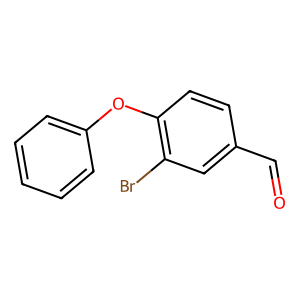
BENZYL (2-BROMO-4-FORMYL-PHENYL) ETHER
Names and Identifiers of BENZYL (2-BROMO-4-FORMYL-PHENYL) ETHER
CAS Number |
1000414-11-8 |
|---|---|
IUPAC Name |
3-bromanyl-4-phenoxy-benzaldehyde |
Canonical SMILES |
C1=CC=C(C=C1)OC2=C(C=C(C=C2)C=O)Br |
Physical and chemical properties of BENZYL (2-BROMO-4-FORMYL-PHENYL) ETHER
Exact Mass |
275.97900 |
|---|---|
LogP |
4.05390 |
Molecular Formula |
C13H9BrO2 |
Molecular Weight |
277.11300 |
PSA |
26.30000 |
Applications of BENZYL (2-BROMO-4-FORMYL-PHENYL) ETHER
3-Bromo-4-phenoxybenzaldehyde has various applications:
- Organic Synthesis: It serves as an intermediate in the synthesis of pharmaceuticals and agrochemicals.
- Material Science: The compound can be used in developing new materials with specific properties due to its unique structural features.
- Research Tool: Its reactivity makes it valuable in research settings for studying reaction mechanisms and developing new synthetic methodologies.
Interaction Studies of BENZYL (2-BROMO-4-FORMYL-PHENYL) ETHER
Interaction studies involving 3-bromo-4-phenoxybenzaldehyde focus on its reactivity with biological macromolecules and other small molecules. Research indicates that this compound can influence metabolic pathways by interacting with enzymes, potentially altering their activity or stability. Such interactions may provide insights into its pharmacological effects and help identify potential therapeutic applications.
Biological Activity of BENZYL (2-BROMO-4-FORMYL-PHENYL) ETHER
The biological activity of 3-bromo-4-phenoxybenzaldehyde is of interest due to its potential pharmacological properties. It has been reported to exhibit significant activity in biochemical pathways, influencing cellular processes such as apoptosis and oxidative stress responses. The compound's role as a reactant in synthesizing complex organic molecules suggests that it may interact with enzymes and proteins, facilitating various bio