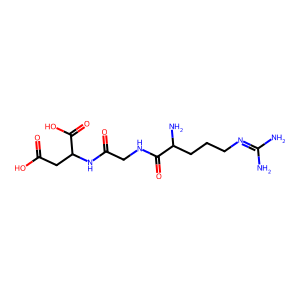
Arginyl-glycyl-aspartic acid
CAS No.:
99896-85-2
M. Wt:
346.340
M. Fa:
C12H22N6O6
InChI Key:
IYMAXBFPHPZYIK-BQBZGAKWSA-N
Appearance:
White Solid
Names and Identifiers of Arginyl-glycyl-aspartic acid
CAS Number |
99896-85-2 |
|---|---|
IUPAC Name |
(2S)-2-[[2-[[(2S)-2-amino-5-(diaminomethylideneamino)pentanoyl]amino]acetyl]amino]butanedioic acid |
InChI |
InChI=1S/C12H22N6O6/c13-6(2-1-3-16-12(14)15)10(22)17-5-8(19)18-7(11(23)24)4-9(20)21/h6-7H,1-5,13H2,(H,17,22)(H,18,19)(H,20,21)(H,23,24)(H4,14,15,16)/t6-,7-/m0/s1 |
InChIKey |
IYMAXBFPHPZYIK-BQBZGAKWSA-N |
Canonical SMILES |
C(CC(C(=O)NCC(=O)NC(CC(=O)O)C(=O)O)N)CN=C(N)N |
Isomeric SMILES |
C(C[C@@H](C(=O)NCC(=O)N[C@@H](CC(=O)O)C(=O)O)N)CN=C(N)N |
UNII |
78VO7F77PN |
Physical and chemical properties of Arginyl-glycyl-aspartic acid
Acidity coefficient |
2.85±0.10(Predicted) |
|---|---|
Density |
1.6±0.1 g/cm3 |
Exact Mass |
346.160095 |
Index of Refraction |
1.648 |
LogP |
-1.94 |
Melting Point |
153-155℃ (ethyl ether ) |
Molecular Formula |
C12H22N6O6 |
Molecular Weight |
346.340 |
PSA |
220.72000 |
Solubility |
Soluble in 0.1N acetic acid at 20mg/ml |
Storage condition |
−20°C |
Water Solubility |
Soluble in 0.1N acetic acid at 20mg/ml |
Applications of Arginyl-glycyl-aspartic acid
Arg-Gly-Asp has numerous applications across various fields:
- Biomedical Research: Used extensively in studies involving cell adhesion and migration.
- Tissue Engineering: Incorporated into scaffolds to promote cell attachment and proliferation.
- Drug Delivery Systems: Utilized as targeting ligands for delivering therapeutic agents specifically to cells expressing integrin receptors.
- Diagnostic Imaging: Radiolabeled versions of Arg-Gly-Asp are employed in positron emission tomography for imaging tumors.
Interaction Studies of Arginyl-glycyl-aspartic acid
Research on Arg-Gly-Asp interactions focuses on its binding affinity to different integrins. Studies have shown that variations in the sequence can significantly affect binding strength and specificity. For instance, cyclic forms of Arg-Gly-Asp have been developed to enhance stability and receptor affinity. Interaction studies often utilize techniques such as surface plasmon resonance and fluorescence resonance energy transfer to quantify binding interactions.
Biological Activity of Arginyl-glycyl-aspartic acid
Arg-Gly-Asp exhibits significant biological activity through its role as an integrin-binding motif. It is known to mediate various cellular processes:
- Cell Adhesion: The tripeptide promotes adhesion of cells to the extracellular matrix by binding to specific integrin receptors.
- Cell Migration: It plays a role in guiding cell movement during wound healing and tissue repair.
- Apoptosis: Certain studies indicate that Arg-Gly-Asp peptides can induce apoptosis in cells lacking survival signals by activating pro-caspase-3 pathways.
- Tumor Targeting: Arg-Gly-Asp has been utilized in cancer therapies for targeting tumor vasculature through integrin αvβ3.
Physical sample testing spectrum (NMR) of Arginyl-glycyl-aspartic acid

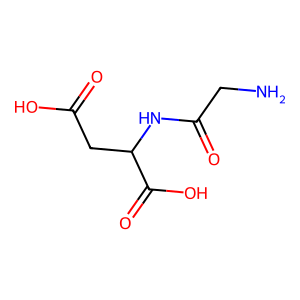 Cas:4685-12-5

 Cas:108787-79-7

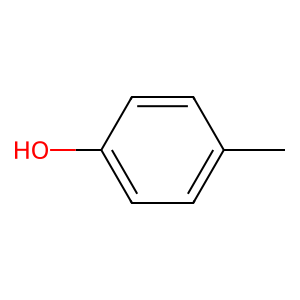 Cas:106-44-5
 Cas:108-98-5