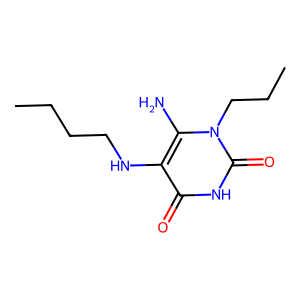
6-amino-5-(butylamino)-1-propylpyrimidine-2,4(1H,3H)-dione
CAS No.:
99991-93-2
M. Wt:
240.30200
M. Fa:
C11H20N4O2
InChI Key:
NRFSRNQYQZSBOL-UHFFFAOYSA-N
Names and Identifiers of 99991-93-2
CAS Number |
99991-93-2 |
|---|---|
IUPAC Name |
6-amino-5-(butylamino)-1-propylpyrimidine-2,4-dione |
InChI |
InChI=1S/C11H20N4O2/c1-3-5-6-13-8-9(12)15(7-4-2)11(17)14-10(8)16/h13H,3-7,12H2,1-2H3,(H,14,16,17) |
InChIKey |
NRFSRNQYQZSBOL-UHFFFAOYSA-N |
Canonical SMILES |
CCCCNC1=C(N(C(=O)NC1=O)CCC)N |
Physical and chemical properties of 99991-93-2
Density |
1.17g/cm3 |
|---|---|
Exact Mass |
240.15900 |
Index of Refraction |
1.552 |
LogP |
1.80730 |
Molecular Formula |
C11H20N4O2 |
Molecular Weight |
240.30200 |
PSA |
93.17000 |
Solubility |
>36 [ug/mL] (The mean of the results at pH 7.4) |
Safety Information of 99991-93-2

Applications of 99991-93-2
6-amino-5-(butylamino)-1-propylpyrimidine-2,4(1H,3H)-dione has several applications:
- Medicinal Chemistry: It serves as a scaffold for developing new pharmaceutical agents targeting various diseases.
- Proteomics Research: Utilized in studies involving protein interactions and enzyme assays due to its ability to modify protein structures.
- Chemical Biology: Acts as a tool compound for investigating biochemical pathways and cellular processes.
These applications reflect its significance in both academic research and industrial settings .
Interaction Studies of 99991-93-2
Interaction studies involving 6-amino-5-(butylamino)-1-propylpyrimidine-2,4(1H,3H)-dione focus on its binding affinity with biological macromolecules:
- Protein Binding Assays: Investigating how this compound interacts with target proteins can reveal insights into its mechanism of action.
- Enzyme Kinetics: Studies on enzyme inhibition provide valuable data regarding its potential therapeutic effects.
Such studies are crucial for understanding the pharmacodynamics of the compound and guiding further drug development efforts .
Biological Activity of 99991-93-2
Research indicates that 6-amino-5-(butylamino)-1-propylpyrimidine-2,4(1H,3H)-dione exhibits various biological activities. It has been studied for its potential as an inhibitor in enzymatic pathways and its role in cellular signaling processes. Specific biological activities include:
- Antimicrobial Properties: Preliminary studies suggest that this compound may possess antimicrobial activity against certain bacterial strains.
- Anticancer Potential: There is emerging evidence supporting its use in cancer therapeutics due to its ability to interfere with tumor cell proliferation.
- Enzyme Inhibition: The compound may inhibit specific enzymes involved in metabolic pathways, making it a candidate for drug development .