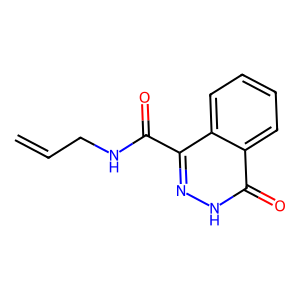
N-allyl-4-oxo-3,4-dihydrophthalazine-1-carboxamide
CAS No.:
99989-14-7
M. Wt:
229.23
M. Fa:
C12H11N3O2
InChI Key:
RHZKAEYCYUEAML-UHFFFAOYSA-N
Names and Identifiers of 99989-14-7
CAS Number |
99989-14-7 |
|---|---|
MDL Number |
MFCD03197328 |
IUPAC Name |
4-oxo-N-prop-2-enyl-3H-phthalazine-1-carboxamide |
InChI |
InChI=1S/C12H11N3O2/c1-2-7-13-12(17)10-8-5-3-4-6-9(8)11(16)15-14-10/h2-6H,1,7H2,(H,13,17)(H,15,16) |
InChIKey |
RHZKAEYCYUEAML-UHFFFAOYSA-N |
Canonical SMILES |
C=CCNC(=O)C1=NNC(=O)C2=CC=CC=C21 |
UNSPSC Code |
12352100 |
Physical and chemical properties of 99989-14-7
Molecular Formula |
C12H11N3O2 |
|---|---|
Molecular Weight |
229.23 |
Safety Information of 99989-14-7

Applications of 99989-14-7
N-allyl-4-oxo-3,4-dihydrophthalazine-1-carboxamide has potential applications in various fields:
- Pharmaceutical Development: Due to its biological activity, it may serve as a lead compound in drug discovery targeting infectious diseases or cancer.
- Agricultural Chemicals: Its antimicrobial properties could be explored for use in agricultural fungicides or bactericides.
Interaction Studies of 99989-14-7
Interaction studies are crucial for understanding the pharmacokinetics and pharmacodynamics of N-allyl-4-oxo-3,4-dihydrophthalazine-1-carboxamide. Initial findings suggest:
- Binding Affinity: Investigations into its binding affinity with various biological targets (e.g., enzymes or receptors) are necessary to elucidate its mechanism of action.
- Synergistic Effects: Combining this compound with other antimicrobial agents may enhance its efficacy against resistant strains.
Biological Activity of 99989-14-7
Preliminary studies indicate that N-allyl-4-oxo-3,4-dihydrophthalazine-1-carboxamide exhibits potential biological activities. It has been noted for its:
- Antimicrobial Properties: The compound shows effectiveness against certain bacterial strains, making it a candidate for further pharmacological development.
- Anticancer Activity: Some derivatives of phthalazine compounds have been associated with anticancer effects, suggesting that N-allyl derivatives may also possess similar properties.