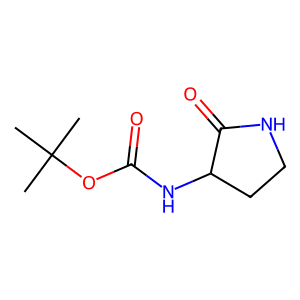
tert-Butyl (2-oxopyrrolidin-3-yl)carbamate
CAS No.:
99780-97-9
M. Wt:
200.235
M. Fa:
C9H16N2O3
InChI Key:
DVWCHAUBYVZILO-UHFFFAOYSA-N
Appearance:
White Solid
Names and Identifiers of 99780-97-9
CAS Number |
99780-97-9 |
|---|---|
EC Number |
847-779-0 |
MDL Number |
MFCD11007813 |
IUPAC Name |
tert-butyl N-(2-oxopyrrolidin-3-yl)carbamate |
InChI |
InChI=1S/C9H16N2O3/c1-9(2,3)14-8(13)11-6-4-5-10-7(6)12/h6H,4-5H2,1-3H3,(H,10,12)(H,11,13) |
InChIKey |
DVWCHAUBYVZILO-UHFFFAOYSA-N |
Canonical SMILES |
CC(C)(C)OC(=O)NC1CCNC1=O |
UNSPSC Code |
12352100 |
Physical and chemical properties of 99780-97-9
Acidity coefficient |
11.05±0.20(Predicted) |
|---|---|
Boiling Point |
394.0±31.0 °C at 760 mmHg |
Density |
1.1±0.1 g/cm3 |
Exact Mass |
200.116089 |
Flash Point |
192.1±24.8 °C |
Index of Refraction |
1.491 |
LogP |
-0.99 |
Molecular Formula |
C9H16N2O3 |
Molecular Weight |
200.235 |
PSA |
67.43000 |
Storage condition |
2-8°C |
Vapour Pressure |
0.0±0.9 mmHg at 25°C |
Safety Information of 99780-97-9

Applications of 99780-97-9
tert-Butyl (2-oxopyrrolidin-3-yl)carbamate finds applications in various fields:
- Pharmaceuticals: Its derivatives are explored for potential therapeutic uses due to their biological activity.
- Chemical Research: Used as an intermediate in organic synthesis for developing more complex molecules.
- Agricultural Chemistry: Investigated for use in agrochemicals due to its potential pest control properties.
Interaction Studies of 99780-97-9
Interaction studies involving tert-butyl (2-oxopyrrolidin-3-yl)carbamate primarily focus on its binding affinity to biological targets such as enzymes and receptors. These studies often employ techniques like:
- Molecular Docking: To predict how the compound interacts with specific proteins.
- In Vitro Assays: To evaluate its efficacy against microbial strains or enzyme activity.
Such studies help elucidate the mechanism of action and potential therapeutic applications of this compound.
Biological Activity of 99780-97-9
The biological activity of tert-butyl (2-oxopyrrolidin-3-yl)carbamate has been explored in various studies. It exhibits potential pharmacological properties, including:
- Antimicrobial Activity: Some derivatives of pyrrolidine compounds have shown efficacy against certain bacterial strains.
- CNS Activity: Compounds with similar structures have been investigated for their effects on the central nervous system, indicating possible applications in neuropharmacology.
- Enzyme Inhibition: Certain studies suggest that pyrrolidine derivatives may act as inhibitors for specific enzymes, which could be beneficial in therapeutic contexts.
Physical sample testing spectrum (NMR) of 99780-97-9

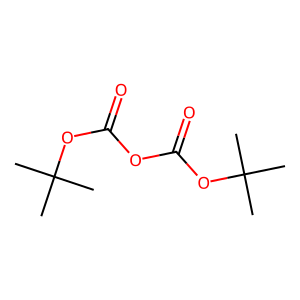 Cas:24424-99-5

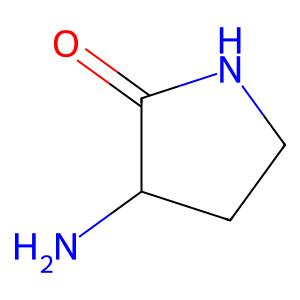 Cas:4128-00-1

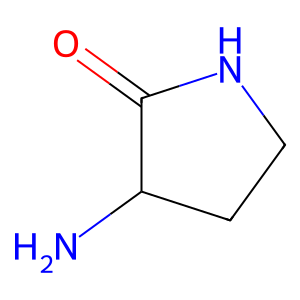 Cas:2483-65-0
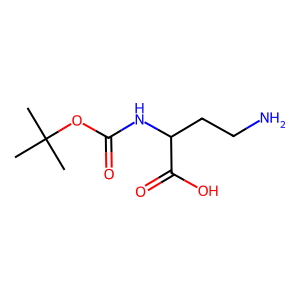 Cas:25691-37-6