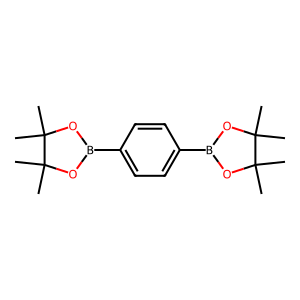
1,4-Bis(4,4,5,5-Tetramethyl-1,3,2-dioxaborolan-2-yl)benzene
CAS No.:
99770-93-1
M. Wt:
330.034
M. Fa:
C18H28B2O4
InChI Key:
UOJCDDLTVQJPGH-UHFFFAOYSA-N
Appearance:
Solid
Names and Identifiers of 99770-93-1
CAS Number |
99770-93-1 |
|---|---|
EC Number |
691-283-5 |
MDL Number |
MFCD08276852 |
IUPAC Name |
4,4,5,5-tetramethyl-2-[4-(4,4,5,5-tetramethyl-1,3,2-dioxaborolan-2-yl)phenyl]-1,3,2-dioxaborolane |
InChI |
InChI=1S/C18H28B2O4/c1-15(2)16(3,4)22-19(21-15)13-9-11-14(12-10-13)20-23-17(5,6)18(7,8)24-20/h9-12H,1-8H3 |
InChIKey |
UOJCDDLTVQJPGH-UHFFFAOYSA-N |
Canonical SMILES |
B1(OC(C(O1)(C)C)(C)C)C2=CC=C(C=C2)B3OC(C(O3)(C)C)(C)C |
UNSPSC Code |
12352100 |
Physical and chemical properties of 99770-93-1
Boiling Point |
416.3±28.0 °C at 760 mmHg |
|---|---|
Density |
1.0±0.1 g/cm3 |
Exact Mass |
330.217377 |
Flash Point |
205.6±24.0 °C |
Index of Refraction |
1.490 |
LogP |
2.28500 |
Melting Point |
241-245ºC |
Molecular Formula |
C18H28B2O4 |
Molecular Weight |
330.034 |
PSA |
36.92000 |
Solubility |
soluble in Toluene |
Storage condition |
Keep in dark place,Sealed in dry,Room Temperature |
Vapour Pressure |
0.0±0.9 mmHg at 25°C |
Safety Information of 99770-93-1

Applications of 99770-93-1
1,4-Bis(4,4,5,5-tetramethyl-1,3,2-dioxaborolan-2-yl)benzene is primarily utilized in:
- Organic Synthesis: As a key intermediate in the preparation of various organic compounds.
- Pharmaceutical Development: Its role in cross-coupling reactions makes it valuable for synthesizing complex pharmaceuticals.
- Material Science: It is used in developing functional materials due to its unique structural properties.
Interaction Studies of 99770-93-1
Interaction studies involving 1,4-bis(4,4,5,5-tetramethyl-1,3,2-dioxaborolan-2-yl)benzene focus on its reactivity with different substrates during cross-coupling reactions. These studies often explore how variations in substituents on the benzene ring or modifications to the dioxaborolane moiety affect reaction efficiency and selectivity. Understanding these interactions is crucial for optimizing synthetic pathways in organic chemistry.
Physical sample testing spectrum (NMR) of 99770-93-1

 Cas:214360-58-4

 Cas:25015-63-8

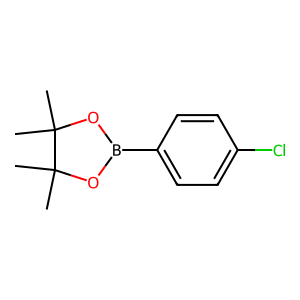 Cas:195062-61-4
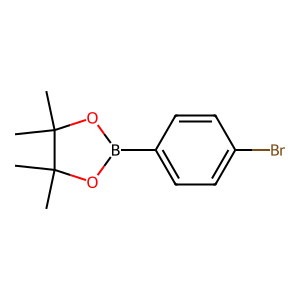 Cas:68716-49-4