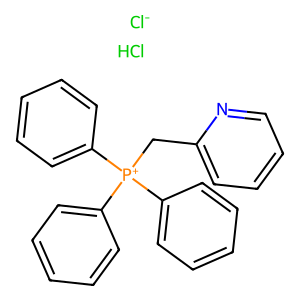
Triphenyl(2-pyridylmethyl)phosphonium chloride hydrochloride
CAS No.:
99662-46-1
M. Wt:
426.31800
M. Fa:
C24H22Cl2NP
InChI Key:
JHQWTRCLYUFMSJ-UHFFFAOYSA-M
Appearance:
Solid
Names and Identifiers of 99662-46-1
CAS Number |
99662-46-1 |
|---|---|
EC Number |
627-509-6 |
IUPAC Name |
triphenyl(pyridin-2-ylmethyl)phosphanium;chloride;hydrochloride |
InChI |
InChI=1S/C24H21NP.2ClH/c1-4-13-22(14-5-1)26(23-15-6-2-7-16-23,24-17-8-3-9-18-24)20-21-12-10-11-19-25-21;;/h1-19H,20H2;2*1H/q+1;;/p-1 |
InChIKey |
JHQWTRCLYUFMSJ-UHFFFAOYSA-M |
Canonical SMILES |
C1=CC=C(C=C1)[P+](CC2=CC=CC=N2)(C3=CC=CC=C3)C4=CC=CC=C4.Cl.[Cl-] |
Physical and chemical properties of 99662-46-1
Exact Mass |
425.08700 |
|---|---|
LogP |
2.38170 |
Melting Point |
249-254ºC(lit.) |
Molecular Formula |
C24H22Cl2NP |
Molecular Weight |
426.31800 |
PSA |
26.48000 |
Safety Information of 99662-46-1

Applications of 99662-46-1
Triphenyl(2-pyridylmethyl)phosphonium chloride hydrochloride finds applications in various fields, including:
- Chemical Research: Used as a reagent in organic synthesis, particularly in reactions requiring phosphonium salts.
- Fluorescent Chemosensors: Its derivatives are employed in developing sensors for detecting pH changes due to their fluorescent properties.
- Biological Studies: Potentially useful in exploring cellular interactions and mechanisms due to its phosphonium nature.
Interaction Studies of 99662-46-1
Interaction studies involving Triphenyl(2-pyridylmethyl)phosphonium chloride hydrochloride primarily focus on its reactivity with biological membranes and other cellular components. Preliminary investigations indicate that similar phosphonium compounds can disrupt membrane integrity, leading to increased permeability and potential cytotoxicity. Further studies are needed to comprehensively understand these interactions and their implications for therapeutic applications.
Physical sample testing spectrum (NMR) of 99662-46-1

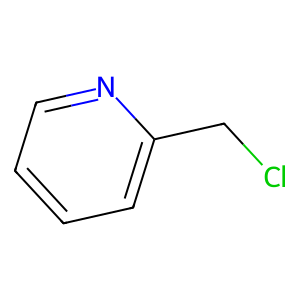 Cas:4377-33-7

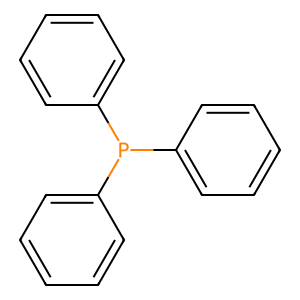 Cas:603-35-0
