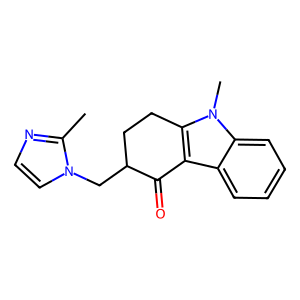
Ondansetron hydrochloride dihydrate
Names and Identifiers of 99614-01-4
CAS Number |
99614-01-4 |
|---|---|
EC Number |
619-449-4 |
IUPAC Name |
9-methyl-3-[(2-methylimidazol-1-yl)methyl]-2,3-dihydro-1H-carbazol-4-one |
InChI |
InChI=1S/C18H19N3O/c1-12-19-9-10-21(12)11-13-7-8-16-17(18(13)22)14-5-3-4-6-15(14)20(16)2/h3-6,9-10,13H,7-8,11H2,1-2H3 |
InChIKey |
FELGMEQIXOGIFQ-UHFFFAOYSA-N |
Canonical SMILES |
CC1=NC=CN1CC2CCC3=C(C2=O)C4=CC=CC=C4N3C |
UNII |
4AF302ESOS |
Physical and chemical properties of 99614-01-4
Acidity coefficient |
7.4(at 25℃) |
|---|---|
Boiling Point |
546ºC at 760mmHg |
Density |
1.27g/cm3 |
Exact Mass |
329.129486 |
Flash Point |
284ºC |
LogP |
log Kow = 3.95 (est) |
Melting Point |
231 - 232 °C |
Molecular Formula |
C18H20ClN3O |
Molecular Weight |
329.824 |
PSA |
39.82000 |
Stability |
Stable under recommended storage conditions. /Ondansetron hydrochloride dihydrate/ |
Storage condition |
−20°C |
Vapour Pressure |
3.7X10⁻¹⁰ mm Hg at 25 °C (est) |
Water Solubility |
H2O: >5 mg/mL |
Safety Information of 99614-01-4


Applications of 99614-01-4
Ondansetron is primarily used in clinical settings for:
- Chemotherapy-Induced Nausea and Vomiting: It is effective in preventing nausea and vomiting associated with highly emetogenic chemotherapy regimens.
- Postoperative Nausea and Vomiting: Ondansetron is also used to manage nausea following surgical procedures.
- Radiation Therapy: It can be administered to patients undergoing radiation therapy to mitigate nausea.
Additionally, ondansetron has been explored for off-label uses in managing other types of nausea, including that related to pregnancy or gastroenteritis.
Interaction Studies of 99614-01-4
Ondansetron has notable interactions with various medications. Specifically:
- Serotonergic Drugs: Concurrent use with selective serotonin reuptake inhibitors or other serotonergic agents can increase the risk of serotonin syndrome, a potentially life-threatening condition characterized by excessive serotonergic activity.
- Cytochrome P450 Enzyme Modulators: Drugs that induce or inhibit cytochrome P450 enzymes may alter ondansetron's metabolism and clearance, necessitating dose adjustments.
Monitoring for adverse effects is essential when ondansetron is used alongside these medications.
Biological Activity of 99614-01-4
Ondansetron exhibits its biological activity by selectively antagonizing the 5-HT3 receptors located in both the central nervous system and peripheral nervous system. This action effectively reduces the incidence of nausea and vomiting by inhibiting the signaling pathways that would typically be activated by serotonin. The drug has demonstrated efficacy in preventing nausea and vomiting induced by highly emetogenic chemotherapy regimens, such as those involving cisplatin.
Physical sample testing spectrum (NMR) of 99614-01-4

 Cas:99614-60-5

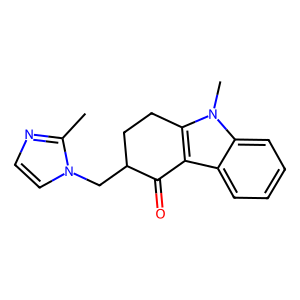 Cas:99614-02-5
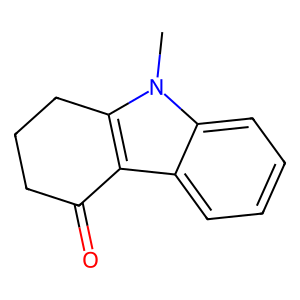 Cas:27387-31-1

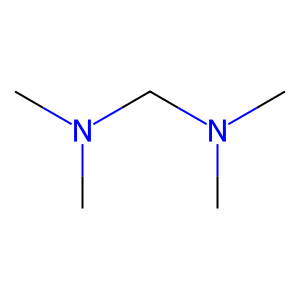 Cas:51-80-9
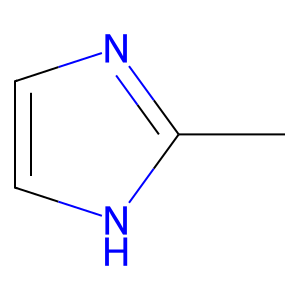 Cas:693-98-1