
2-Amino-4-chloro-6-methylpyrimidine-5-carbonitrile
Names and Identifiers of 99586-66-0
CAS Number |
99586-66-0 |
|---|---|
MDL Number |
MFCD20704020 |
IUPAC Name |
2-amino-4-chloro-6-methylpyrimidine-5-carbonitrile |
InChI |
InChI=1S/C6H5ClN4/c1-3-4(2-8)5(7)11-6(9)10-3/h1H3,(H2,9,10,11) |
InChIKey |
BUGYLQNXUJUMKZ-UHFFFAOYSA-N |
Canonical SMILES |
CC1=C(C(=NC(=N1)N)Cl)C#N |
UNSPSC Code |
12352100 |
Physical and chemical properties of 99586-66-0
Exact Mass |
168.02000 |
|---|---|
LogP |
1.47348 |
Molecular Formula |
C6H5ClN4 |
Molecular Weight |
168.58400 |
PSA |
75.59000 |
Storage condition |
under inert gas (nitrogen or Argon) at 2–8 °C |
Safety Information of 99586-66-0

Applications of 99586-66-0
Due to its unique structural properties, 2-amino-4-chloro-6-methylpyrimidine-5-carbonitrile finds applications in:
- Pharmaceutical Development: It serves as a lead compound for developing new drugs targeting adenosine receptors.
- Chemical Research: Its reactivity makes it valuable for synthesizing other complex organic molecules.
- Agricultural Chemistry: Potential applications in developing agrochemicals that target specific biological pathways.
Interaction Studies of 99586-66-0
Interaction studies have focused on the compound's binding affinity and selectivity towards various receptors. For instance, studies have shown that modifications at positions 4 and 6 can significantly influence the selectivity profile towards adenosine receptors . These interactions are crucial for understanding the pharmacodynamics and pharmacokinetics of derived compounds.
Biological Activity of 99586-66-0
Research indicates that derivatives of 2-amino-4-chloro-6-methylpyrimidine-5-carbonitrile exhibit significant biological activities, particularly as selective ligands for adenosine receptors. These compounds have been shown to act as antagonists in various signaling pathways, which may have implications for treating conditions like cardiovascular diseases and cancer . The structural features of this compound contribute to its selectivity and potency in biological systems.
Physical sample testing spectrum (NMR) of 99586-66-0

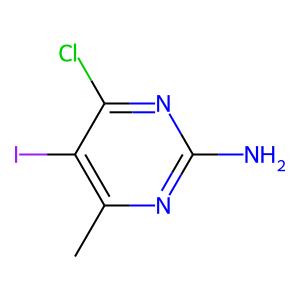 Cas:897030-99-8

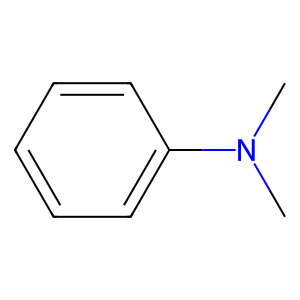 Cas:121-69-7