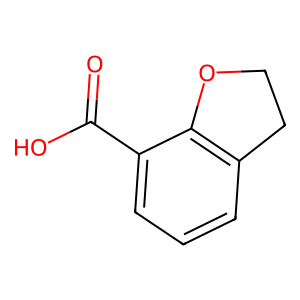
![structure of 5-Nitro-2,3-dihydrobenzo[b]furan-7-carboxylic acid](https://molwiki.oss-cn-hongkong.aliyuncs.com/structure/31/99517-31-4.svg)
5-Nitro-2,3-dihydrobenzo[b]furan-7-carboxylic acid
Names and Identifiers of 99517-31-4
CAS Number |
99517-31-4 |
|---|---|
IUPAC Name |
5-nitro-2,3-dihydro-1-benzofuran-7-carboxylic acid |
InChI |
InChI=1S/C9H7NO5/c11-9(12)7-4-6(10(13)14)3-5-1-2-15-8(5)7/h3-4H,1-2H2,(H,11,12) |
InChIKey |
HGZXANUIYKGGSW-UHFFFAOYSA-N |
Canonical SMILES |
C1COC2=C1C=C(C=C2C(=O)O)[N+](=O)[O-] |
Physical and chemical properties of 99517-31-4
Acidity coefficient |
3.37±0.20(Predicted) |
|---|---|
Boiling Point |
411.3±45.0 °C(Predicted) |
Density |
1.561±0.06 g/cm3(Predicted) |
Exact Mass |
209.03200 |
LogP |
1.75110 |
Melting Point |
249-251.5 °C |
Molecular Formula |
C9H7NO5 |
Molecular Weight |
209.15600 |
PSA |
92.35000 |
Applications of 99517-31-4
5-Nitro-2,3-dihydrobenzo[b]furan-7-carboxylic acid finds applications in various fields:
- Organic Synthesis: It serves as an intermediate in synthesizing more complex organic molecules.
- Pharmaceuticals: Its derivatives may be crucial in developing active pharmaceutical ingredients (APIs) due to their biological activities.
- Agrochemicals: The compound can be utilized in producing agrochemicals.
Interaction Studies of 99517-31-4
Studies focusing on the interactions of 5-nitro-2,3-dihydrobenzo[b]furan-7-carboxylic acid with biological systems have highlighted its potential as an antimicrobial agent. The nitro group plays a pivotal role in its reactivity and interaction with various cellular targets. Further research is needed to elucidate specific pathways and mechanisms involved in its biological activity.
Biological Activity of 99517-31-4
Research indicates that furan derivatives, including 5-nitro-2,3-dihydrobenzo[b]furan-7-carboxylic acid, exhibit various biological activities. These compounds have been shown to possess antibacterial, antifungal, and antiviral properties. The mechanism of action is primarily attributed to the nitro group, which can undergo bioreduction to form reactive intermediates that interact with cellular components, leading to antimicrobial effects. Specific molecular targets and pathways may vary depending on the biological context and organism involved.
Physical sample testing spectrum (NMR) of 99517-31-4

 Cas:35700-40-4
