![structure of 6-bromo-1,2-dimethyl-1H-benzo[d]imidazole](https://molwiki.oss-cn-hongkong.aliyuncs.com/structure/64/99512-64-8.svg)
6-bromo-1,2-dimethyl-1H-benzo[d]imidazole
CAS No.:
99512-64-8
M. Wt:
225.08500
M. Fa:
C9H9BrN2
InChI Key:
XXPOCWQCTILEQZ-UHFFFAOYSA-N
Appearance:
Gray Solid
Names and Identifiers of 99512-64-8
CAS Number |
99512-64-8 |
|---|---|
MDL Number |
MFCD16250431 |
IUPAC Name |
6-bromo-1,2-dimethylbenzimidazole |
InChI |
InChI=1S/C9H9BrN2/c1-6-11-8-4-3-7(10)5-9(8)12(6)2/h3-5H,1-2H3 |
InChIKey |
XXPOCWQCTILEQZ-UHFFFAOYSA-N |
Canonical SMILES |
CC1=NC2=C(N1C)C=C(C=C2)Br |
UNSPSC Code |
12352100 |
Physical and chemical properties of 99512-64-8
Exact Mass |
223.99500 |
|---|---|
H Bond Acceptors |
1 |
H Bond Donors |
0 |
LogP |
2.64420 |
Molecular Formula |
C9H9BrN2 |
Molecular Weight |
225.08500 |
PSA |
17.82000 |
Safety Information of 99512-64-8

Applications of 99512-64-8
6-Bromo-1,2-dimethyl-1H-benzo[d]imidazole has several applications:
- Pharmaceuticals: Due to its biological activity, it is explored as a lead compound in drug discovery for cancer treatment and antimicrobial agents.
- Material Science: Its unique structural properties make it suitable for developing novel materials with specific functionalities.
- Chemical Research: The compound serves as an important intermediate in organic synthesis for creating more complex molecules.
Interaction Studies of 99512-64-8
Studies on the interactions of 6-bromo-1,2-dimethyl-1H-benzo[d]imidazole reveal its ability to bind to various proteins and enzymes:
- Kinase Inhibition: It has been shown to inhibit key kinases involved in cell signaling pathways, affecting cellular processes such as growth and survival.
- Enzyme Modulation: The compound interacts with enzymes related to metabolic pathways, leading to changes in cellular metabolism and function.
Biological Activity of 99512-64-8
The biological activity of 6-bromo-1,2-dimethyl-1H-benzo[d]imidazole is notable, particularly in its interactions with various biological targets:
- Anticancer Properties: This compound has demonstrated potential in inhibiting key kinases involved in cancer cell proliferation, such as epidermal growth factor receptor (EGFR) and cyclin-dependent kinase 2 (CDK2), leading to cell cycle arrest and apoptosis in cancer cells.
- Antimicrobial Activity: It exhibits antibacterial and antifungal properties, making it a candidate for further exploration in antimicrobial therapy.
- Anti-inflammatory Effects: The compound has shown promise in reducing inflammation through modulation of relevant biochemical pathways.
Physical sample testing spectrum (NMR) of 99512-64-8

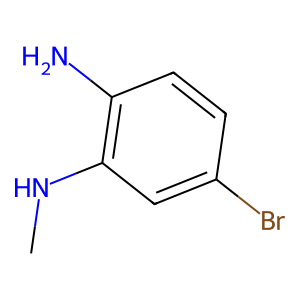 Cas:337915-79-4
