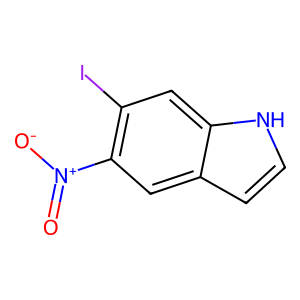
6-iodo-5-nitro-1H-indole
Names and Identifiers of 6-iodo-5-nitro-1H-indole
CAS Number |
1000343-00-9 |
|---|---|
IUPAC Name |
6-iodanyl-5-nitro-1H-indole |
Canonical SMILES |
C1=CNC2=CC(=C(C=C21)[N+](=O)[O-])I |
Physical and chemical properties of 6-iodo-5-nitro-1H-indole
Boiling Point |
429.8±30.0 °C at 760 mmHg |
|---|---|
Density |
2.1±0.1 g/cm3 |
Exact Mass |
287.939575 |
Flash Point |
213.7±24.6 °C |
Index of Refraction |
1.799 |
LogP |
3.35 |
Molecular Formula |
C8H5IN2O2 |
Molecular Weight |
288.042 |
PSA |
61.61000 |
Vapour Pressure |
0.0±1.0 mmHg at 25°C |
Applications of 6-iodo-5-nitro-1H-indole
6-Iodo-5-nitro-1H-indole has several applications across different fields:
- Chemistry: It serves as a building block for synthesizing more complex indole derivatives with potential biological activities.
- Biology: Investigated for antimicrobial and anticancer properties.
- Medicine: Explored for antiviral and anti-inflammatory applications.
- Industry: Utilized in developing new materials and chemical processes due to its unique reactivity .
Interaction Studies of 6-iodo-5-nitro-1H-indole
The mechanism of action for 6-iodo-5-nitro-1H-indole involves its interaction with various molecular targets. The nitro group can be reduced to form reactive intermediates that interact with cellular components, leading to cytotoxic effects. Additionally, the iodine atom may participate in halogen bonding, influencing binding affinity to biological targets . Such interactions could modulate enzymatic activities and signal transduction pathways.
Biological Activity of 6-iodo-5-nitro-1H-indole
Research indicates that 6-iodo-5-nitro-1H-indole exhibits significant biological activities. It has been investigated for its potential as an antimicrobial and anticancer agent, attributed to its ability to interact with various biological targets. The nitro group may undergo reduction within biological systems, generating reactive intermediates that can affect cellular components and induce cytotoxic effects . Additionally, its interactions with enzymes and receptors suggest that it could modulate important biochemical pathways.