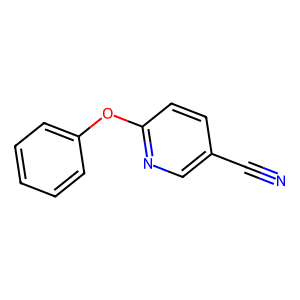
6-Phenoxynicotinonitrile
Names and Identifiers of 6-Phenoxynicotinonitrile
CAS Number |
99902-72-4 |
|---|---|
MDL Number |
MFCD00205454 |
IUPAC Name |
6-phenoxypyridine-3-carbonitrile |
InChI |
InChI=1S/C12H8N2O/c13-8-10-6-7-12(14-9-10)15-11-4-2-1-3-5-11/h1-7,9H |
InChIKey |
FBFTWRLLJHLPNJ-UHFFFAOYSA-N |
Canonical SMILES |
C1=CC=C(C=C1)OC2=NC=C(C=C2)C#N |
UNSPSC Code |
12352100 |
Physical and chemical properties of 6-Phenoxynicotinonitrile
Boiling Point |
340.8ºC at 760 mmHg |
|---|---|
Density |
1.23g/cm3 |
Exact Mass |
196.06400 |
Flash Point |
159.9ºC |
Index of Refraction |
1.613 |
LogP |
2.74558 |
Melting Point |
81 to 83°C |
Molecular Formula |
C12H8N2O |
Molecular Weight |
196.20500 |
PSA |
45.91000 |
Storage condition |
Sealed in dry,Room Temperature |
Safety Information of 6-Phenoxynicotinonitrile

Applications of 6-Phenoxynicotinonitrile
6-Phenoxynicotinonitrile has several notable applications:
- Pharmaceuticals: Its potential anti-cancer properties make it a candidate for drug development.
- Organic Synthesis: It serves as an intermediate in synthesizing more complex organic molecules, particularly those containing heterocycles.
- Research Tool: Used in studies investigating the mechanisms of action of various therapeutic agents.
These applications underscore its significance in both research and industry.
Interaction Studies of 6-Phenoxynicotinonitrile
Interaction studies involving 6-Phenoxynicotinonitrile focus on its binding affinity and activity against specific biological targets. These studies often employ techniques such as:
- Molecular Docking: To predict how the compound interacts with target proteins.
- In vitro Assays: To evaluate its cytotoxicity and mechanism of action against different cell lines.
- Pharmacokinetic Studies: To assess absorption, distribution, metabolism, and excretion properties.
Such studies are crucial for understanding the compound's potential therapeutic effects and safety profile.
Biological Activity of 6-Phenoxynicotinonitrile
6-Phenoxynicotinonitrile has been studied for its biological activities, particularly its potential as an anti-tumor agent. Research indicates that it may exhibit cytotoxic effects against various cancer cell lines. The compound's ability to interact with biological targets makes it a candidate for further investigation in drug development, particularly in targeting pathways involved in cancer proliferation and survival.
Physical sample testing spectrum (NMR) of 6-Phenoxynicotinonitrile

 Cas:557-21-1

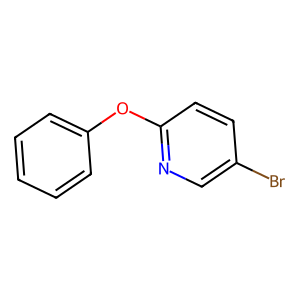 Cas:59717-96-3

 Cas:108-95-2
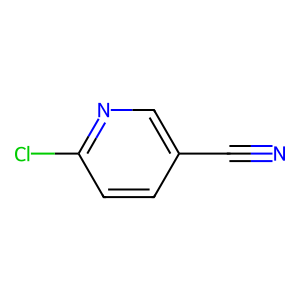 Cas:33252-28-7